whizzy1919@gmail.com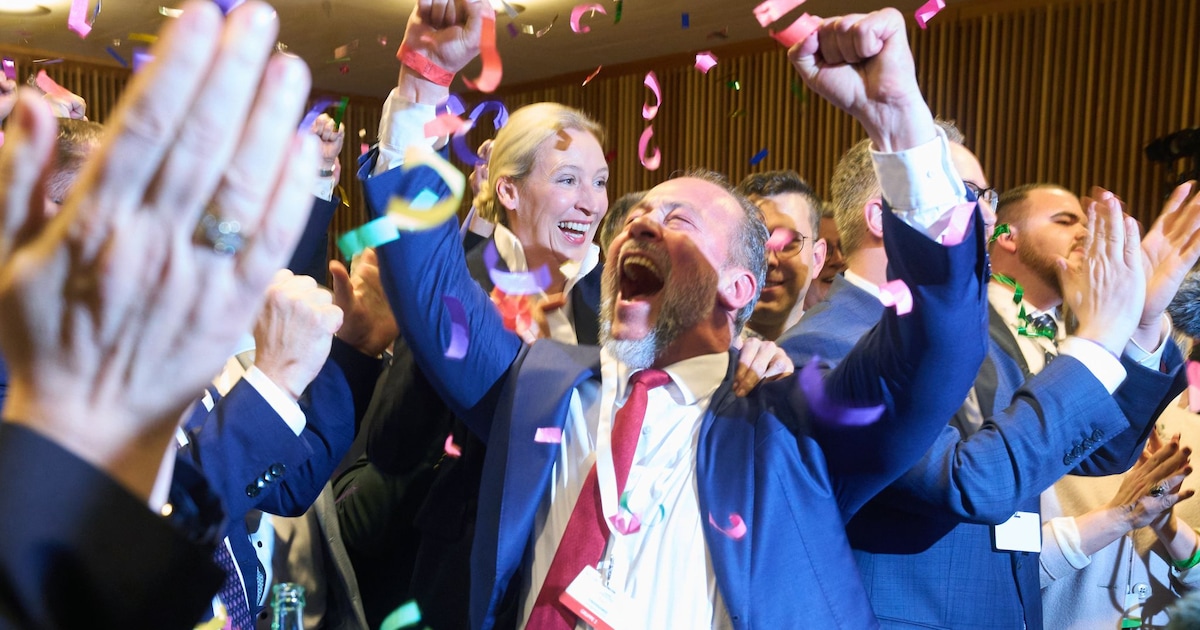
The AfD gets 20 percent each in two wealthy western countries. The other parties ignore what is happening. It has dramatic consequences.
Even after its great electoral success, the AfD plays no role in the analysis of the Union and the SPD. The election winner in Rhineland-Palatinate, Gordon Schnieder from the CDU, says he “never” wants and will govern with the AfD. So the inventory is over again.
AfD questions the system and delivers oppressive lessons
Or, as the liberal-conservative politics professor Andreas Rödder says: “Shut up, dead monkey.” There is no strategy that goes beyond saying “never with them.” The AfD has long been asking a system question and providing oppressive lessons.
The AfD is currently celebrating great successes – in the two generally wealthy western states of Baden-Württemberg and Rhineland-Palatinate it has more than doubled. Almost 20 percent of people voted for each of them. This is associated with the biggest change in the political system of the Federal Republic since its founding.
Intrigues, affairs – people still vote for the AfD
The AfD voters did not allow themselves to be deterred by sleazy cousin affairs, unknown or dubious candidates – and certainly not by the taboo treatment of the AfD by all other parties.
The faction leader in the Rhineland-Palatinate parliament, top AfD official Frisch, who resigned in anger, accuses her of “nepotism, intrigue and ineffective promises of advancement for third-class regular politicians.” Everyone could hear it, everyone could also watch the leading candidate Bollinger formulating questionable sentences (“Push until the runway glows”).
And yet the AfD has established itself, even in the West, even though it is only a dozen years old. And already, as Rödder analyzes it at “Welt”, it is on the “path to becoming a people’s party”. The AfD is clearly in the process of achieving what the Greens, who brought about the first major change in the Federal Republican party system at the beginning of the 1980s, always dreamed of – in vain.
Party of Workers – and Young People
And if you look at the post-election surveys, it turns out that the AfD is number 1 in Rhineland-Palatinate among younger people, those under 24 years old. The AfD has not only become the “workers’ party”, but also the most important projection of the – deeply insecure – young people, and it is the party that mobilizes the most non-voters. With such a profile, the SPD would no longer be able to stop celebrating.
The other parties have been thinking the same thing about the AfD for years: it is right-wing extremist, a party of the frustrated and outraged that they will “never” get involved with. It was of no use – no political project is as unsuccessful as the “fight against the right”.
The establishment of the AfD, in combination with the tabooization and “diabolization” of the party by other parties, has “dramatic consequences for the ability of the political system to act,” says political scientist Rödder. The so-called firewall has a positive dual function for the right and the left, but weakens the Union. For the AfD, the firewall is an “immense instrument of solidarity” and for the left-wing parties it is an “immense instrument for maintaining power”.
The firewall is a prison for the CDU
For the Union, the firewall is a prison of its own choosing. 81 percent of CDU voters are against cooperation with the AfD. They obviously still prefer stagnation or frustration.
AfD leader Alice Weidel says bluntly that the taboo policies of others benefit her party. Rödder bluntly describes the consequences of the firewall for the political system: “There is no longer any change of government.”
If Friedrich Merz when the CDU leader and Chancellor says that the AfD is out of the question as a government partner and that the FDP is “dead”, then the only thing left is a government that pursues at least half left-wing politics. With regard to power options, Merz should have looked after the FDP earlier. Instead, he fought them like an opponent of the system. If the FDP disappears, the biggest loser will be the Union.
,regionOfInterest=(1439,423)&hash=40b9a275794ceac776f59b7c081e5c743ff2fd9f0a357557bcddb883a41ad067)
Reforms? Even Merz doubts it
Whether the Union governs with the SPD or with the Greens shouldn’t make a big difference. Especially since the SPD has become significantly greener over the years. And the fate of the state in Rhineland-Palatinate should not depend on whether the Prime Minister there is called Alexander Schweitzer (SPD) as before or as Gordon Schnieder (CDU) in the future.
There is little prospect of an improvement in coalition conditions in Berlin. The SPD leader Lars Klingbeil was asked this Monday whether “reforms” would finally come with the Union. Whereupon he said that his “concept of reform” was completely different than that of the Union.
There are a number of examples of this: At Miosga, SPD man Karl Lauterbach said that the retirement benefits of higher-earning pensioners had to be capped in order to give more to poorer pensioners.
The SPD wants to “reform” the debt brake, i.e. abolish it – despite record debts, despite record interest rates, despite record taxes. She can’t get enough. The Union is still resisting.
AfD parliamentary manager Bernd Baumann is looking forward to it: “The big announced reforms will not come.”
When it comes to addressing the people, the AfD has better ideas. While the distance between the CDU/SPD and the people is growing, the AfD is renting closed bars in the villages in order to chat with citizens over sausage and wine. This didn’t occur to Schweitzer, a campaigner who was supposedly so committed.
The other parties must finally develop an “AfD strategy,” warns Rödder. It doesn’t look like that. They seem to be resigned, stewing in their own juice. Merz is asked how he deals with the fact that two thirds (!) of voters do not trust the federal government to make positive changes because they are fundamentally skeptical. The Chancellor simply answers:
“I share this skepticism.”