whizzy1919@gmail.com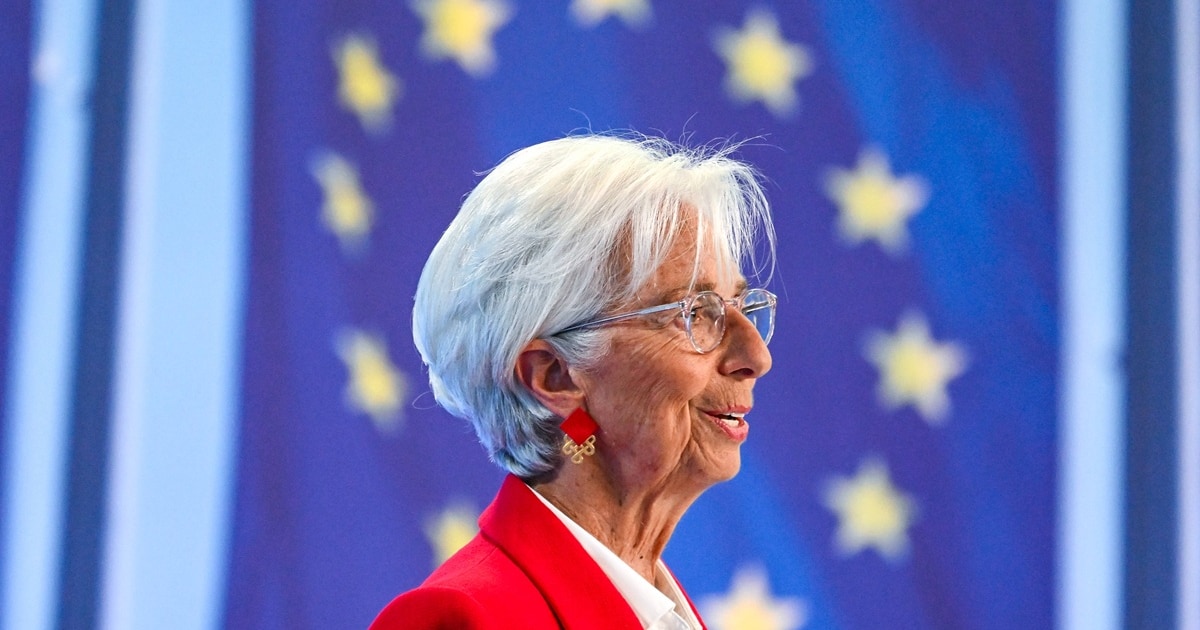
Officially, Christine Lagarde will remain in office until 2027. But behind the scenes the pressure is growing – not because of inflation, but because of Macron’s waning power. A Spaniard could benefit from this.
In Frankfurt am Main, where the euro is not printed but is controlled from the upper floors of the European Central Bank tower, a debate is brewing about the president’s future: Christine Lagarde’s contract officially runs until October 31, 2027. But British media in particular are speculating whether she will leave sooner and want to have good sources for this. The president herself rejects this, but the rumors continue.
The reason lies not in their monetary policy, not in inflation, nor in the usual tension between hawks and doves. The reason is in Paris. There, President Emmanuel Macron is already being described as the “lame duck in the Élysée Palace,” a head of state with dwindling influence whose ability to control European personnel decisions is visibly eroding. And before it disappears completely, he could pull off a coup and have a say in the most important European financial top post. That’s exactly why the clock starts ticking for Lagarde.
“Lame duck” in the Élysée Palace
Anyone who listens to European central banking circles will experience something like relaxed anticipation. No – Christine Lagarde, who left the room in Davos insultedwill not take off her hat tomorrow. But yes, she might not stay until the end, but leave her post at the beginning of next year, is the opinion.
If you want to understand how the top management of the ECB is appointed, you have to look less at economic balance sheets and forecasts and more at political geography. The decision about the occupation was never a transparent competition, but always a discreet arrangement between Paris and Berlin, a balance of interests, influence and mutual consideration.
ECB Tower in Frankfurt is a center of power
Rome and Madrid were occasionally allowed to have a say; smaller states were only generously included as a common denominator on which people could agree once the decision had been made. The glass ECB Tower in Frankfurt is not a technocratic temple, but a center of power. In times of high inflation, growing debt and geopolitical tensions, the central bank is more than ever a political instrument.
The situation is reminiscent of a game of chess, in which it is not the next move that counts, but the position in three moves. France has with us Lagarde took office despite harsh criticism already occupied the most important position. In the European power arithmetic, a second mandate for Paris is considered almost impossible to implement, especially since Macron has just run afoul of domestic politics and European partners are beginning to reorganize their options. At the same time, Southern Europe’s self-confidence is growing. Spain, a long-time observer, is pushing into the center. Italy is looking for allies. The northern states want stability but fear political dominance.
Discreet arrangement between Berlin and Paris
In this context, some candidates appear stronger than others, regardless of their monetary policy concepts. The German Bundesbank President Joachim Nagel, for example, is hardly taken seriously in central bank circles anymore. Germany is considered too big, too orthodox and not capable of compromise to embody the European consensus. Instead, the debate boils down to two names that represent two political styles.
We hear that there is the Dutchman Klaas Knot, head of the Dutch central bank for a long time, a representative of classic stability policy, characterized by monetary discipline, skeptical about permanent bond purchases and expansionary fiscal policy. His supporters see him as a return to the old order, to a central bank that focuses more on price stability.
And there is the Spaniard Pablo Hernández de Cos, currently general director of the Bank for International Settlements in Basel, internationally connected, politically clever and acceptable to North and South. Its advantage lies not only in profile, but in geography: Spain has never had the ECB president. In Brussels and the capitals, this is seen as a strong argument, almost as an overdue correction in the European balance.
Spain beats the Netherlands and Germany anyway
As this decision looms, the focus in Paris and Berlin is shifting to the second tier, to those positions that are less visible but often more crucial than the president himself. This is where the intellectual architecture of monetary policy is being designed. The ECB’s chief economist, the Irishman Philip Lane since 2019, largely determines the analytical framework in which decisions are made. The German economist Markus Brunnermeier, an internationally recognized financial theorist who could build bridges between stability and pragmatism, is considered a possible successor.
At the same time, the successor to the German board member Isabel Schnabel is being considered, whose influence on capital markets, communication and the strategic direction of the ECB has grown significantly in recent years. Whoever occupies this position often has a greater influence on operational monetary policy than the president himself.
Focus on the second row
The fact that all these movements are being followed closely is due to a development that is rarely openly expressed in Europe: the creeping politicization of the central bank’s essentially independent monetary policy. While in the United States the debate over the independence of the Federal Reserve System is loud and visible, in Europe it takes place quietly, almost politely, in conversations behind closed doors, in confidential papers and strategic personnel decisions. But the question is the same: How independent can a central bank remain when it decides on government financing, banking stability, climate risks and geopolitical shocks and the top jobs are only chosen in deals between top politicians?
A premature departure of Lagarde would therefore be more than just a change in personnel. It would be a signal that the ECB’s political phase is not over, but that monetary policy is in the middle of it. The markets would adapt quickly. But the actual effect lies deeper. It would show that European integration continues to be controlled by national centers of power, even if the institutions have long appeared supranational.
Europe’s monetary policy is decided in the capitals
Europe’s monetary policy is not decided in Frankfurt, not in the plenary hall of the European Parliament and not in academic debates. It is decided in the capitals, in conversations that are rarely recorded, in compromises that are never made public. As long as this remains the case, the ECB will remain independent and political.
Article written by Business punk.