whizzy1919@gmail.com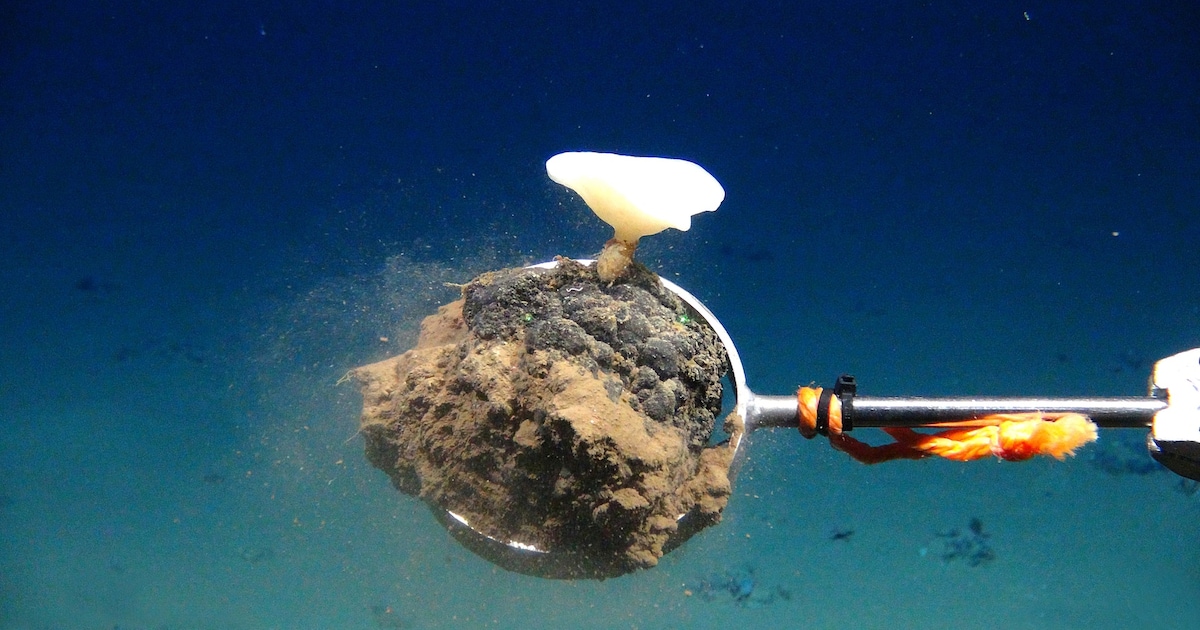
Is deep-sea mining imminent? Authorities are struggling to come up with rules, companies are testing robots, researchers are warning about environmental consequences. And US President Trump is rushing forward with a decree. The responsible authority is now meeting.
Life in this deep-sea region proceeds slowly, almost in extreme slow motion: the conditions at the bottom of the so-called Clarion-Clipperton Zone in the eastern Pacific appear to have hardly changed over millions of years. “Life in the deep sea is very slow because very little food arrives here,” says Matthias Haeckel from the Geomar Helmholtz Center for Ocean Research Kiel.
The calm could soon be over. Because here, halfway between Hawaii and Mexico, the seabed at a depth of 4,000 to 6,000 meters is littered with manganese nodules that contain sought-after raw materials. Like potatoes in a field, they lie on the muddy sediment. Or better: they grow there.
Metal ions accumulate in a circle around a nucleus – something like a shark tooth or a small stone – and cause the nodules to grow slowly: by a few millimeters per million years. A 15 centimeter tuber is estimated to be five to ten million years old. Researchers assume that the local environmental conditions have hardly changed over this period.
Despite the eternal darkness, the enormous pressure, and the extremely nutrient-poor environment, an extremely diverse community of creatures thrives here – precisely because of the tubers: sponges grow on this hard substrate, deep-sea corals thrive, and worms build their limestone tubes.
Largest potential mining area in the world
You can also find brittle stars, sea anemones as well as small octopuses and shrimps, deep-sea crabs, giant isopods measuring up to 45 centimeters in size and sea cucumbers such as the headless chicken monster (Enypniastes eximia). The nutrient-poor deep sea supports only relatively few individuals, but an extreme diversity of species.
And that is largely unknown. Because no one knows exactly what is going on in the Clarion-Clipperton zone. In 2023, a research team in the journal “Current Biology” estimated the number of animal species to be around 5,600 – around 90 percent of which are still undescribed.
The nine square kilometer area is known – roughly equivalent to the area of Europe – but because of the manganese nodules. They contain valuable mineral resources such as cobalt, nickel, copper and rare earths. And because such raw materials – for example for batteries in electric cars – are in high demand, the Clarion-Clipperton zone is considered the largest potential mining area in the world.
There are other deep sea areas rich in raw materials
According to a Geomar brochure, there are an average of 15 kilograms of manganese nodules per square meter – in some places possibly even up to 75 kilos. The total mass is estimated at 21 billion tons. However, the proportion of valuable raw materials in the nodules is low: According to the information, nickel accounts for 1.3 percent of the mass, copper 1 percent, and cobalt 0.2 percent. Nevertheless, this area alone contains three to five times more nickel and cobalt than all terrestrial deposits combined, it is said.

Other deep-sea areas are also rich in raw materials: polymetallic sulfides are deposited around hydrothermal vents, such as black smokers on the Mid-Atlantic Ridge, and submarine mountains contain cobalt-rich iron manganese crusts, as Christian Müller from the Federal Institute for Geosciences and Natural Resources (BGR) explains. “But manganese nodules have received the greatest attention in recent years,” says the head of the BGR Marine Raw Materials Exploration Department. “The research and the first steps towards extraction are already very advanced.”
For around 40 years, a number of countries – including Germany – have been exploring the ecosystems and conditions for deep-sea mining in defined areas, especially in the Clarion-Clipperton Zone. So far it has failed due to a few hurdles:
- The far-reaching consequences of dismantling for the predominantly unknown environment are still largely not understood.
- Collecting the manganese nodules including transport to the surface and industrial processing is complex and expensive. This makes mining economically risky.
- Rules for deep sea mining in international waters have not yet been determined. The International Seabed Authority (ISA), based in Jamaica, whose council meets from March 9, has been working on this for many years.
But with rising raw material prices and more sophisticated technology, natural resources are becoming more interesting. Meanwhile, companies such as the Canadian The Metals Company or the Belgian DEME Group and its subsidiary Global Sea Mineral Resources (GSR) are concretely preparing for mining.
Worrying practical test
Scientists have been researching what this would mean in practice for decades – such as the German project Discol (Disturbance and Recolonization) in the Peru Basin. In 1989, about 650 kilometers southeast of the Galápagos Islands, researchers experimentally plowed an area of 11 square kilometers at a depth of around 4,100 meters.
26 years later, an expedition returned with the research ship “Sonne”. The traces of the plow were still visible on the seabed. “Not much had happened there,” says Haeckel.
And in 2021, the coordinator of the MiningImpact project in the Clarion-Clipperton zone monitored what exactly happens when the manganese nodules are harvested. A tank-like tracked vehicle drove over the seabed, used a high-pressure water jet to loosen the manganese nodules from the bottom and sucked them up along with the sediment with a large proboscis. In the collectors, the tubers were screened out using a steel grid, while everything else was separated out in a cloud of particles.

“Everything gets sucked in”
The consequences of this approach are catastrophic for the inhabitants of the deep sea: “It’s not just the tubers that are sucked in, but everything that lives on and underneath them,” says Haeckel. “The living layer is completely removed. All larger sea creatures perish.” Even a year and a half later there was still no resettlement in the area.
There is a simple reason for this: on the muddy seabed, the manganese nodules literally form the basis of the ecosystem, as a solid basis for corals, sponges and worms, which in turn attract other sea creatures. “Where manganese nodules are present, there is more diversity,” says Haeckel. Completely different species lived there; the number of individuals was two to five times higher than in comparable areas without manganese nodules.
But the method examined also completely removes the top five to ten centimeters of the mud, which is home to a number of organisms. With a deposition rate of 0.5 centimeters per 1,000 years, this calculates to take 10,000 to 20,000 years for the sediment to be replenished.
“The habitat is gone,” says Haeckel, “this world is gone.” The expert believes that the conditions of the test were realistic and could be transferred to other areas of the Clarion-Clipperton zone.
“Technically it could start”
Another test followed in 2022: The Metals Company harvested 3,000 tons of manganese nodules in the Clarion-Clipperton zone and also transported them to the water surface. And the US-Canadian company Impossible Metals is planning another test for 2027, says BGR expert Müller: Here, autonomous AI-controlled units with several gripping arms on the underside will collect the tubers individually – and spare colonized tubers.
But how realistic is resource extraction in the near future? Haeckel is skeptical: “At the moment the costs are so high that they cannot cover the dismantling,” he says. “The prices for cobalt, nickel and copper would have to triple.”
BGR expert Müller sees it differently: “If private companies with a lot of money set out on this path, it is at least possible to see that it is economically feasible,” he says. “The first steps towards deep-sea mining are already very advanced.”
And the former director of the Alfred Wegener Institute, Antje Boetius, believes that raw material prices are very volatile and investments are therefore risky for companies. “In order to make a profit, huge areas would have to be cleared,” says the president of the Californian Monterey Bay Aquarium Research Institute (MBARI).
There are also many unexplained processes, says the deep-sea expert: In addition to the ecological consequences, this primarily concerns the extremely complex extraction of the metals and the disposal of the highly toxic heavy metal waste at sea. Not only environmentalists but also the fishing industry are concerned about such plans.
“Deep sea mining can never be sustainable”
Can raw materials from the deep sea even be exploited sustainably? “Probably not, because the raw materials neither grow back nor can we humans cure interventions,” says Boetius.
BGR expert Müller avoids the term sustainability. “But in my opinion, environmentally friendly deep-sea mining is possible,” he says. To do this, the impact on biodiversity must be minimized. In addition, such mining only affects a minimal proportion of the huge deep-sea areas.
Haeckel emphasizes: “We are not talking about one or two mining areas, but about 20 to 40 parallel projects, each per year on 200 square kilometers of mining area.” For comparison: Cologne has an area of around 400 square kilometers.
The ISA is now continuing to negotiate international rules for deep-sea mining. Around 40 states of the 172 members of the International Seabed Authority (ISA) have spoken out in favor of a ban, a moratorium or a pause, including Germany. Regardless US President Donald Trump issued a decree last springthat US companies are also allowed to conduct deep-sea mining in international waters.
The conditions under which this will happen remain open, says Müller. He expects a “lean” process. “It is quite possible that environmental regulations will be minimized.”
FOCUS online Earth is dedicated to the climate crisis and how to overcome it.
Fact-centered. Well-founded. Constructive. Every Friday as a newsletter.