whizzy1919@gmail.com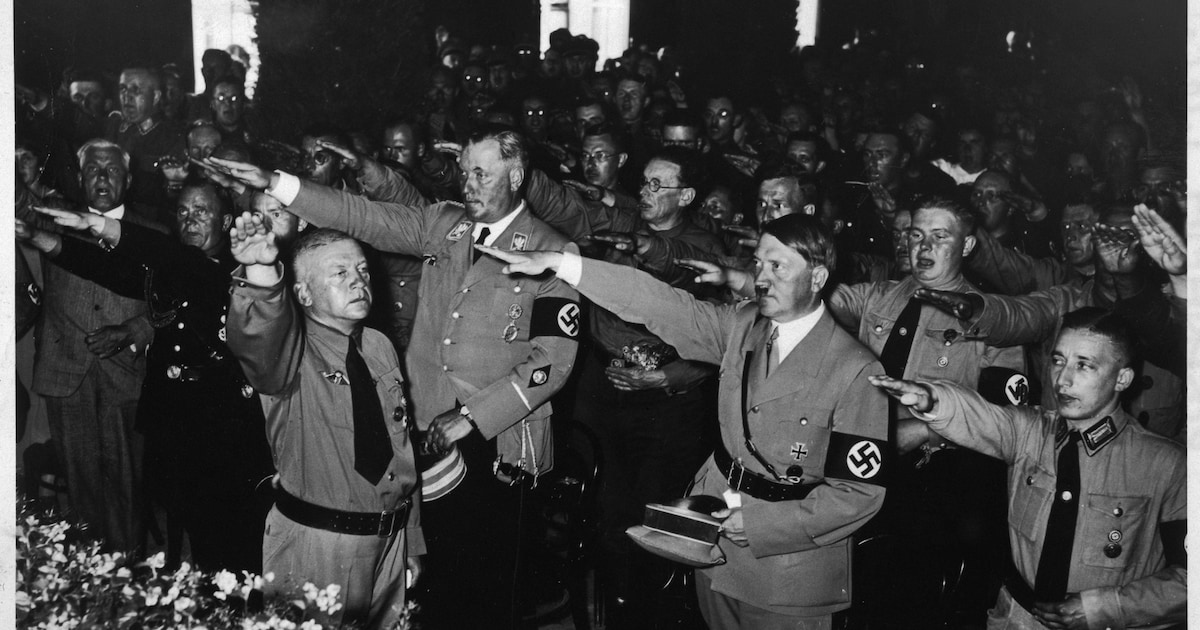
Stephanie Hollenstein was a well-known painter and cultural official during the Third Reich. Although she was a lesbian, she worshiped Hitler and Nazism.
The anticipation is great. On March 11, 1938, torches and pillars with swastikas were placed in front of the house in Lustenau in Vorarlberg, Austria. Swastika flags are displayed on the balcony of the house at Pontenstrasse 20.
The background for the high spirits is the expected “annexation” of Austria Nazi Germany. This happens the following day with the entry of Wehrmacht troops into the future “Ostmark”.
A year later, the homeowner wrote about the building decorations in a letter: “Because we, along with everyone else, were happy to welcome our brothers and sisters from the motherland.”
Contradiction to Nazi ideology
The owner of the modern house, which she designed herself, has been a convinced ethnic anti-Semite for many years and is also an enthusiastic National Socialist. Her name: Stephanie Hollenstein.
In 1934 she joined the NSDAP, which was banned in her home country of Austria. Now the day has finally come when Germany’s “leader” brings the “Ostmark” “home into the Reich”. Stephanie Hollenstein celebrates.
She is not alone in this – millions of Austrians are cheering Hitler’s arrival. But Hollenstein is a special case. The 48-year-old not only works as a successful and important expressionist painter, but she is also a lesbian.
Both are diametrically opposed to the National Socialists’ worldview. Especially since Hollenstein has been openly living out her sexual preference for decades – a number of lovers bear witness to this. She has now lived with her partner, the doctor Franziska Groß, for years. You have to be blind to miss that.
Unusual career
But how can a lesbian woman warm up to the anti-Semitic, racist, artistically backwards and homophobic Nazi ideology? The Austrian art historian Nina Schedlmayer explores this question in her recently published biography of Hollenstein. The title: “Hitler’s queer artist”.
The book is well researched and exciting to read. Schedelmayer goes back to Hollenstein’s birth in 1886. As the offspring of poor farmers and embroiderers, as a young girl she painted nature and animals with self-made brushes while herding cows in the meadow.
Because of her precarious and rural origins, it was unusual that she was able to go to art school in Munich in 1907 at the age of 18. From then on, the young Stephanie lives in Schwabing, where the bohemians gather, she immerses herself in the artist scene and builds up a network.
At the same time she discovers her same-sex attractions. She soon has her first relationships. However, she must be a difficult partner – dominant and domineering, ruthless and selfish. Yes, she probably displays typical male macho behavior.
As a “soldier” at the front
Hollenstein likes to appear in men’s clothing. And she is a convinced patriot – which is quite unusual for her circles. When the First World War finally broke out on August 1, 1914, she initially volunteered as a medic.
But Hollenstein wants more: she wants to go to the front and fight herself. As a woman, she is forbidden from doing this, but she has a plan. She disguises herself as a man – she wears her hair boyishly short anyway – and applies to the Vorarlberg “Standschützen” under the name Stephan Hollenstein.
In fact, it was adopted and deployed on the Italian Southern Front. Her comrades soon see through the game, but do not betray her. The fraud was only discovered after three months, when a high-ranking officer discovered it while visiting the troops. Hollenstein is sent home. She later worked as a war painter for the army and returned to the front several times.
Support from Jews
During the war she discovered her hatred of the Jews. Here, too, a contradiction develops that is difficult to explain. Hollenstein has Jewish sponsors in the art world, without whom she would hardly have survived the difficult times of the 1920s.
Because the sale of her pictures wasn’t going so well at the time. The Jewish art collector and patron Ludwig Neumark in particular helps her and – like other artists – regularly invites her to dinner once a week.
Hollenstein is even good friends with his wife Friederike; Some whisper that it is more than a platonic friendship between women. After the “Anschluss”, however, Hollenstein deleted any reference to her Jewish supporters and friends from her CV. She wants to forget this part of her past.
Important role for female artists
She feels increasingly attracted to fascism. Here too, a contradiction arises, because Hollenstein is one of the co-founders of the “Association of Female Artists of Austria” (VBKÖ), which successfully advocates for female artists in a largely male-dominated world of art.

She later became president of the National Socialist successor organization to the VBKÖ. Hollenstein is now successful as an artist and is also an important functionary in the art world.
Are you aware of the image of women that Adolf Hitler propagated in Germany? Schedlmayer asks himself. At the Nazi party rally in 1934 explains the “leader”: “The word about women’s emancipation is a word invented only by the Jewish intellect, and the content is shaped by the same spirit.”
The woman’s world is her husband, her family, her children, her house, he adds and emphasizes: “What the man uses in heroism on the battlefield, the woman uses in eternally tolerated devotion, in eternally tolerated suffering and endurance.” The program of the National Socialist women’s movement only contained one point: “the child”.
As a lesbian in a homophobic system
Hollenstein seems to completely ignore this misogynistic ideology. The same applies to the situation of lesbian women under National Socialism. The Nazi regime did not explicitly prohibit lesbian relationships between women – unlike homosexual relationships between men.
However, women who live with women can also be arrested. In Austria, however, the regulations were stricter until the “Anschluss” and here, too, women were put into camps just because they were lesbians.
Nothing happens to Hollenstein. Finally, in 1943, she was anonymously denounced as a lesbian, which had no consequences. But that doesn’t stop Hollenstein from remaining a convinced Nazi supporter. Until her unexpected death: On May 24, 1944, she died as a result of a heart attack at the age of just 57.
It took decades after the end of the “Third Reich” for the art world to face reality and recognize that Stephanie Holleinstein was a convinced National Socialist and anti-Semite.
The question of how this attitude fits into her life as a lesbian has not yet been clarified. She contradicted Nazi ideology with every fiber of her being. Also in her understanding of her role, because she was independent, childless, an artist who refused marriage as well as motherhood, writes historian Schedlmayer.
Historian: “Self-humiliation”
The author offers a possible explanation for how this contrast can be explained: cognitive dissonance. There is a kind of self-abasement in this, but also the ability to adjust things that don’t actually fit so that they seem suitable.
One thing is clear: homosexuality and adherence to a radical and homophobic ideology, be it right-wing extremism or Islamism, are not necessarily mutually exclusive.
Today the “Queers for Palestine” show this openly and actively. When it comes to right-wing extremism, the “queer community” is just waking up from its dream that “queer” and “right-wing” are necessarily mutually exclusive.