whizzy1919@gmail.com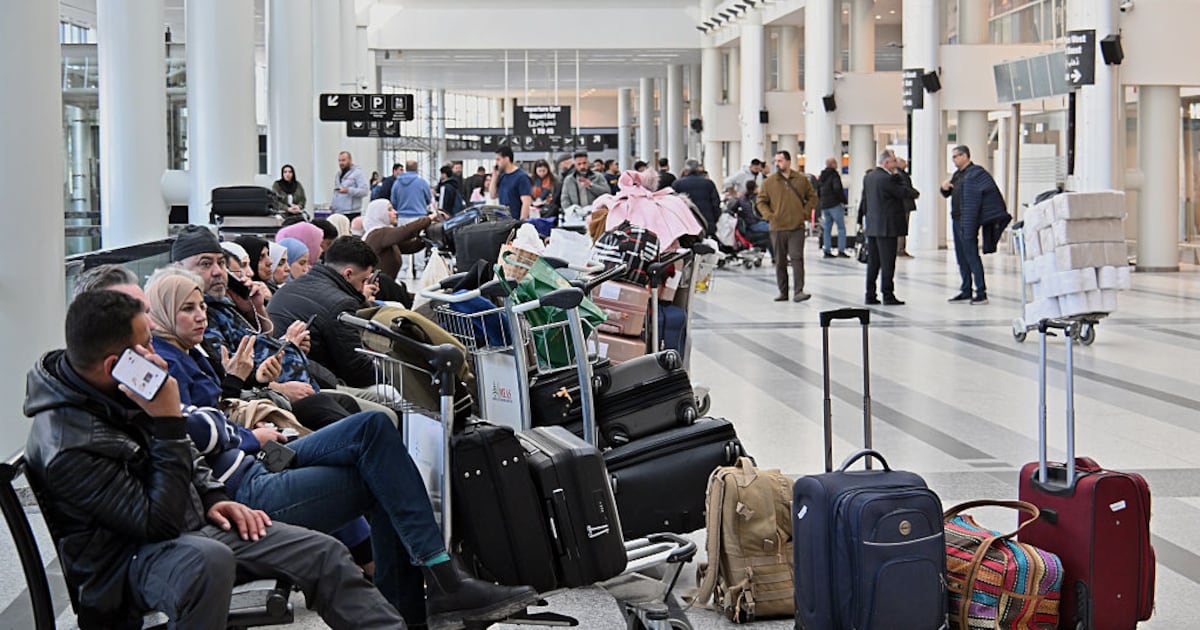
The Germans evacuated from the Middle East are being asked to pay. That’s right, because the state is not a fully comprehensive insurer for voluntary risky trips. A comment.
Tensions have been increasing in the crisis region around Iran and the Gulf region for weeks. Intelligence reports, diplomatic threats – even indications of possible escalations. In addition Warnings from the Foreign Office from possible airspace closures and flight cancellations. Anyone who wanted to know could know.
Nevertheless, thousands flew there. Then the outrage follows: the federal government must fly them out immediately. You shouldn’t “let holidaymakers down”. But. One may. At least when people have made a conscious risk decision.
Evacuation is not part of the holiday package
Evacuations are not a service. They are exceptional security policy operations. Kabul 2021: Military in constant deployment, top logistical performance. Lebanon 2006: Navy and air force in large-scale operation. That costs millions. It binds planes, soldiers, diplomats. It blocks capacities that are intended for real emergencies.
Yes, the state has a duty to protect its citizens. But it is not a fully comprehensive insurer for private holiday decisions. If people travel to potential crisis regions despite warnings – out of a sense of adventure, price advantage or ignorance – then that is a legitimate, free decision. But the state’s duty to protect is not limitless and it is certainly not a free pass for consciously taking risks.
The debate about repatriation flights reveals a mentality problem
What is becoming visible in the current debate is a mentality problem. Take risks – yes. Bear the consequences – no. You enjoy the freedom of vacationing in a crisis region. And in an emergency, you can expect fully comprehensive government protection. This is exactly how moral hazard arises:
- Risk is individualized.
- Costs are socialized.
- Responsibility is delegated.
And every time the state reflexively steps in, it cements this behavior. We know exactly this pattern. Think of the floods in the Eifel. Houses in designated risk areas, no natural hazard insurance – even though it was available. When the flood came, the state stepped in with billions. The signal: prevention optional; Rescue guaranteed.
Or the COVID-19 outbreak: Despite urgent instructions from the German Embassy in Australia to book a return ticket immediately, some people waited. When the airspace closed, there was great outrage. In the end, the state organized an elaborate return campaign – for people who had deliberately hesitated. Here too, the signal is fatal: privately ignore the risk; Protect losses collectively. It is precisely this logic that threatens to be repeated during crisis trips.
We don’t need outrage, but should use the current situation to set clear rules for the future. Anything else creates false incentives.
- Retrieval only with mandatory cost contribution. Anyone who travels despite an official travel warning will contribute substantially to the return costs in the event of an emergency.
- Compulsory insurance when traveling to regions with an official warning. No exit without proof. Risk must have a price.
- Evacuation only if there is immediate danger to life. Not in abstract danger situations or political unrest.
“But what about families who are stuck?”
Of course, it doesn’t just affect adventurers. It also affects families. Children. People who believed that things would work out. But here too, no one was forced to travel. It’s not about business travelers under government mandate, but about private decisions. Duty to protect means help in an emergency – not securing a voluntary decision to take a risk.
Anyone traveling with children to a region that is characterized by political tensions or for which there are even official warnings is not making an emotional but rather a rational decision. And rationality involves risk assessment. Especially those who have responsibility for others have to calculate risks more conservatively – not more overconfidently.
If we do not use this claim as a starting point for evaluating the situation, we suddenly reverse the logic. Should the following then apply: the more emotional the case, the more collective liability is demanded? That may be politically understandable. However, economically it is fatal.
Because when the state begins to evaluate risk decisions based on the degree of concern, it completely dissolves the principle of personal responsibility. Compassion does not replace an incentive structure. Consular support, coordination, information: yes. Automatic full cost evacuation: no.
The inconvenient truth
The state is a protective power – not a parent. Anyone who is adult enough to travel to a crisis region is adult enough to bear the risk themselves. If the state insures every voluntary risk decision, risk becomes rational – because others pay.
The crucial question is not whether we can help. But whether we want to permanently reward wrong behavior. And that’s exactly what determines how serious we really are about personal responsibility.
Peter Holzer has been supporting management teams in demanding changes since 2009 – with a clear eye for leadership, generational change and attitude: consistent in the matter, appreciative in cooperation. He is part of us Experts Circle. The content represents his personal opinion based on his individual expertise.