whizzy1919@gmail.com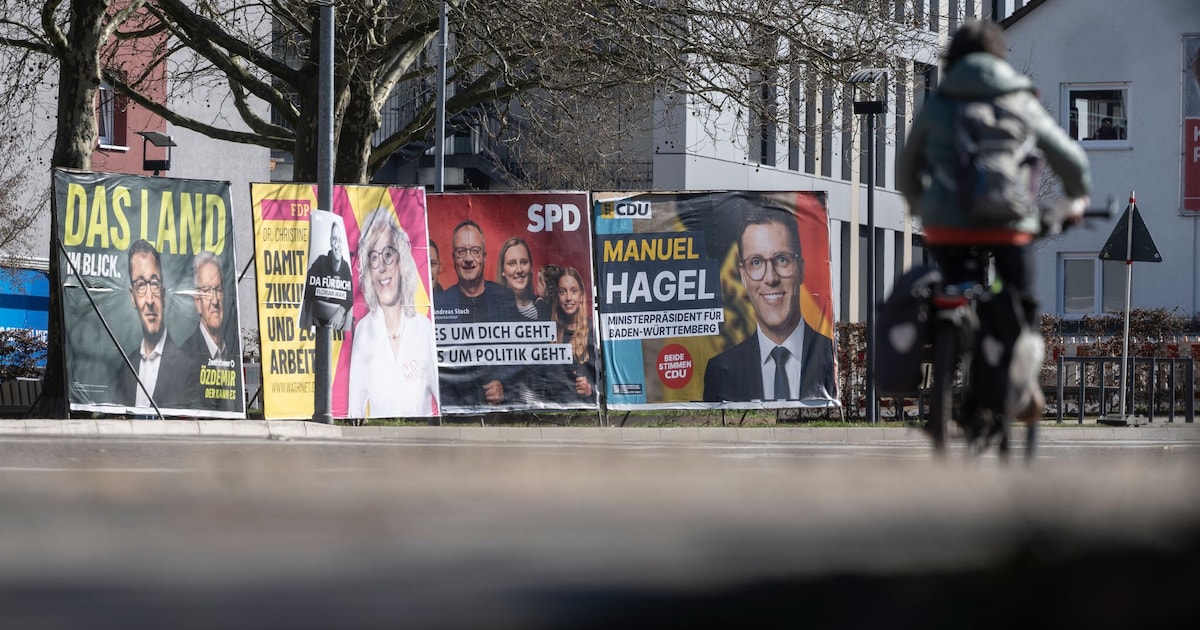
The state election in Baden-Württemberg is the first in years without Kretschmann – and possibly one of the closest in the history of the southwest. Why it is also important for Friedrich Merz.
Of course, state elections are not federal elections. But they are mostly a mood test for the federal government. This is one of the reasons why people are not only looking at Stuttgart this evening from Freiburg or Mannheim – but also from Berlin. The state elections in Baden-Württemberg are the start of the super election year 2026. One thing is also certain: a political era is ending in one of the largest states in the republic.
The polling stations have been open since 8 a.m. and people in the southwest can cast their votes until 6 p.m. Why the choice is so special:
End of Kretschmann’s era
Winfried Kretschmann is no longer running – that alone makes this election historic. After 15 years as Prime Minister of Baden-Württemberg, his name is no longer on the ballot. At the age of 77, the Green politician is retiring. He has governed with the CDU since 2016, and previously with the SPD for five years.
Cem Özdemir (Greens) and Manuel Hagel (CDU) are applying to succeed him. Both are following in big footsteps. Hagel had already declared some time ago that Kretschmann’s legacy was in good hands with the CDU. During the election campaign, Özdemir had Kretschmann displayed on large posters alongside the slogan “You know him”.
A lot to lose for the Greens and the CDU
After many years in the opposition and as junior partners, the Christian Democrats finally sense their chance: They want to move back into Villa Reitzenstein and appoint the head of government – just as they did for many decades in the state before the Kretschmann era. The party hopes to restore what it sees as the “natural order” in the country.
There is also a lot at stake for the Greens. To date, you have been the first and only head of government in Baden-Württemberg. For a long time it seemed as if Kretschmann would remain the only Green Prime Minister. In the polls, the Greens with lead candidate Özdemir were well behind the CDU for months – seemingly uncatchable.
Sudden head-to-head racing and escalation
But a few days before the election, the Greens made significant gains in several surveys. Depending on the survey, they moved within one, two or three percentage points of the CDU. In a recent survey, both parties were tied at 28 percent. Political scientists explained the trend, among other things, with Özdemir’s popularity.

Parallel to this race to catch up, the tone of the election campaign became noticeably sharper. For months, the Greens and the CDU had been comparatively cautious towards each other. Almost two weeks ago, a Green member of the Bundestag published a video of Hagel from 2018. In it, the then 29-year-old spoke enthusiastically about the appearance of a student. The clip spread quickly and sparked widespread criticism.
The CDU is now accusing the Greens of a smear campaign from the bottom drawer. The problem: Regardless of the election outcome, Özdemir and Hagel will probably have to sit down at the table again. Because a coalition of the Greens and the CDU – in whatever order – is currently considered the most likely government option.
Left instead of FDP in the state parliament?
Things also remain exciting for the smaller parties. The five percent hurdle takes on particular importance. The FDP could be thrown out of the state parliament for the first time in its history – of all places in Baden-Württemberg, its home state, where it has been represented for more than 70 years. In the surveys it was recently around six percent.
The Left, on the other hand, could make it into the Baden-Württemberg state parliament for the first time, but according to current surveys they have to tremble. The AfD is likely to become the strongest opposition force – all other parties have ruled out working with them. And the SPD is also under pressure: it has recently remained consistently in the single digits in the surveys, and is threatened with the worst result in its history in the southwest.
New voting rights
For the first time in Baden-Württemberg, 16 and 17 year olds are also allowed to cast their votes. This means that tens of thousands of young voters will be added. In total, around 7.7 million people are eligible to vote – more than ever before, according to the State Statistical Office. It remains to be seen what impact the new young voices will have on the result.

There are also new rules for the distribution of mandates. Voters now have two votes – similar to the federal election. With the first vote, a constituency candidate is directly elected. With the second vote, citizens choose a party. It is crucial for the balance of power in the state parliament. The parties draw up state lists through which candidates can enter parliament.
Battle for the auto industry
The economic situation makes the election even more explosive. Baden-Württemberg is considered the industrial heart of Germany – and is heavily dependent on the automotive industry. The profound structural change is therefore hitting the country particularly hard. Thousands of jobs are at stake, entire regions are looking to the future with concern.
Accordingly, economic policy became the focus of the election campaign: it was about location issues, maintaining jobs and reducing bureaucracy. CDU leading candidate Hagel toured tirelessly from medium-sized company to medium-sized company. “We can drive,” said his green rival Özdemir – and was open to postponing the ban on combustion engines. The CDU is now accusing the Greens of suddenly discovering their love for cars.
Start of the super election year 2026
Last but not least, Sunday evening still has a national political appeal. The state election in Baden-Württemberg is the first of five in a dense election year in 2026 – so it can have a signal effect that extends far beyond the state’s borders. The strategists at the party headquarters in Berlin are watching closely what is happening in the southwest.
If it isn’t enough for Hagel in the end, it could also weaken Chancellor Friedrich Merz (CDU). He came to Ravensburg especially for the end of the election campaign – and said there that the state elections were receiving a lot of attention not only in Baden-Württemberg or Germany, but throughout the EU.
The FDP could lose further importance in federal politics if it were to be kicked out of the state parliament. The Left and AfD, on the other hand, could emerge stronger from the election. It cannot be ruled out that at the end of the year an AfD politician will become the head of a state government for the first time.