whizzy1919@gmail.com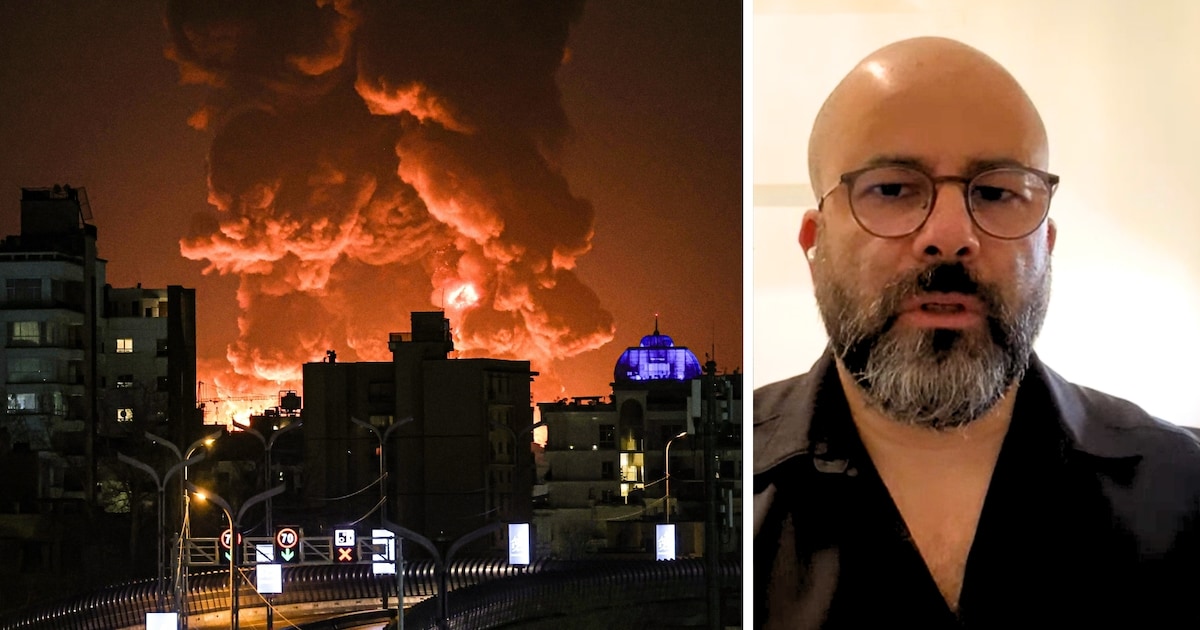
Tehran has been under constant fire for a week, and only a little information from the Iranian capital is leaking out. In an interview, political scientist Arye Sharuz Shalicar provides an insight into the “black box”.
Well over 200 targets have been targeted by the USA and Israel since the war began in Tehran bombed. Rockets and fighter planes can be heard constantly over the city. Over 1,300 people died. Due to internet outages or shutdowns, little information leaks out. Tehran resembles a “black box”. Arye Sharuz ShalicarGerman-Israeli political scientist and writer, gives an insight into what everyday life has been like for people in Tehran since the beginning of the war in an interview with FOCUS online.
USA and Israel have opened “the gates to freedom in Iran”.
“What is happening in Tehran is roughly the same as what is currently happening in many places in Iran, where the Islamic regime has established itself and built up its terror infrastructure over the last 47 years. And attacks are being carried out, both in Tehran and elsewhere, by the US and by Israel – and possibly soon by other allies as well, in order to weaken the terror infrastructure of the Islamic regime as much as possible in order to open the gates to freedom for the people of Iran. That is the great hope that we have.”
“There can be no liberation without military intervention”
It is currently difficult to make contact with Iranians in Tehran. Difficult to capture the mood in the capital. Nevertheless, Shalicar, who has family in Tehran himself, says: “The thousands of videos that were sent around the world before the Americans and Israel deployed, of Iranians who were almost begging for the West to finally intervene and help them free themselves from the clutches of the unjust regime, prove it. Without military intervention, the people of Iran had no chance for decades. No matter how often they took to the streets. No matter how often they tried to demonstrate. They were arrested again and again. Imprisoned, tortured, raped, murdered and without military action, they knew, there would unfortunately be no liberation.”
That’s why he firmly believes that a large proportion of people in Iran are currently very, very happy. “Even though it’s very dangerous right now and most people are staying at home and not going out on the streets yet. But the day will come after the air raid when people can go out on the streets and hopefully take back their country and their freedom.”
“Inhumane actions of the Islamic regime”
In a statement to X, Shalicar wrote that “more and more units of the Iranian terrorist regime are moving their local bases into schools and hospitals in order to abuse their own population as human shields.” In the interview he describes how bad the situation on site actually is:
“It is actually an absolutely inhumane approach by the Islamic regime. Hamas, Islamic Jihad, Hezbollah and other terrorist militias, proxies of the Islamic regime, have done the same thing in recent years. Since October 7, 2023, it has been known that they not only misused human shields to save themselves, but that they actually used schools and hospitals as local terrorist bases and barracks. Because of course the terrorist infrastructures are those of the USA and Israel, such as large office buildings of the Revolutionary Guard ministries, the military or the regime itself – these are clearly marked targets. That is why they are moving to infrastructure that is completely civilian, such as schools and hospitals, in order to deter the Israelis and the Americans from attacking there.
Khamenei’s death marks the beginning of the fall of the regime
After the death of Iran’s leader Ayatollah Ali Khamenei, Shalicar is certain: “I would just say at the top of my head that 95 percent of Iranians worldwide and also in Iran were relieved that this monster, who is responsible for the murder of many, many thousands of Iranians, is no longer with us. And people cheered.” The strike against Khamenei was a kind of “beginning of the fall of the regime,” said the political scientist.
As an exiled Iranian born in Germany with parents living in Tehran, he therefore hopes “that the place of birth of my parents will be freed from the regime and that Iran will become a democracy, an open country.” After 47 years of terror, this cannot happen immediately. But, says Shalicar: “The Americans are currently providing a good template.”