whizzy1919@gmail.com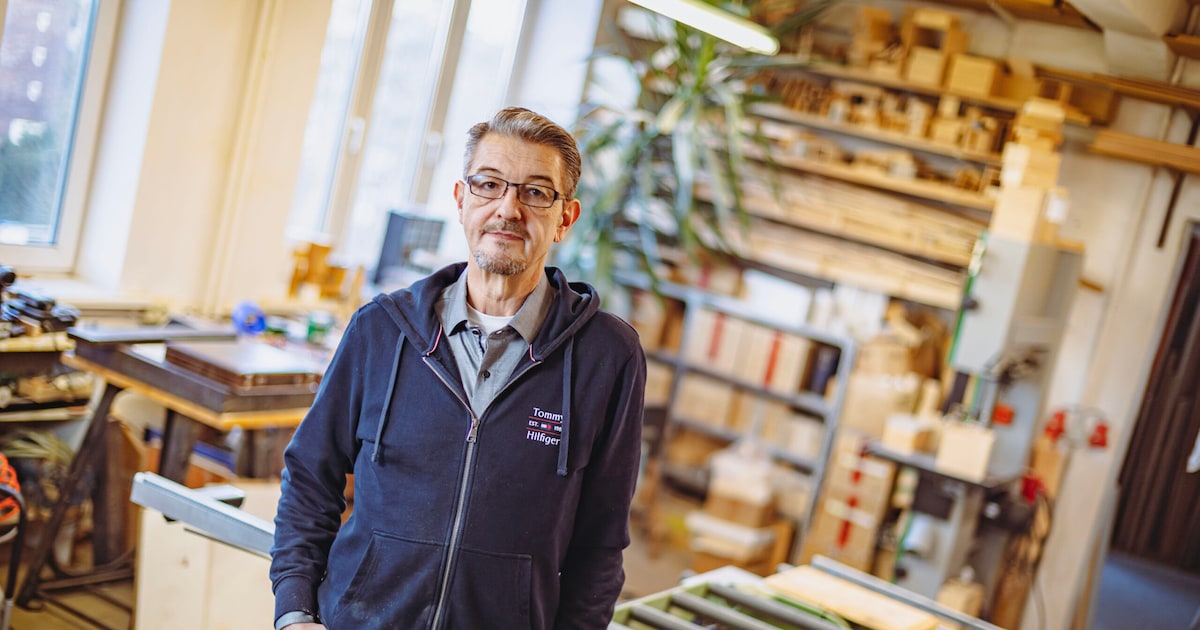
The Hamburg case manufacturer Erich Ludwig has been around for 140 years. It survived a world war and a storm surge. Now owner Andreas Ludwig is looking for a successor – so far without success.
It smells of wood, glue and leather. In a workshop in Hamm, Andreas Ludwig stands between tools and rolls of material and makes cases: for jewelry, cutlery, fine individual pieces. Handcrafted. The 58-year-old is the fourth generation to run the Erich Ludwig case manufacturer. The company has been around for almost 140 years. Still. Because Ludwig is desperately looking for a successor.
“I think it’s a shame that it’s coming to an end for me,” says Ludwig. “An incredible amount of knowledge is lost.”
Succession gap challenges Hamburg companies
In Hamburg, around 24,500 businesses are owned by people aged 57 or older. If you want the company to continue to exist after you leave, you will have to clarify the successor in the next few years. Many people don’t realize that this can be difficult. Society is aging and fewer young people are coming. In addition to the shortage of skilled workers, there is another keyword: successor gap.
In addition, children are less likely to take over their parents’ business. “They often no longer want to work day and night or have other professional qualifications,” says Ayhan Saka. He is a team leader at the Chamber of Commerce’s corporate workshop. The Chambers of Commerce and Crafts offer special advice on the topic.
Saka experiences that many owners start too late. “Handovers are a longer process“, he says. Even in the best case scenario, it takes at least six months – sometimes even years.
No suitable candidate yet
Ludwig notices this too. The 58-year-old took care of it early on because there is no longer any training in the profession. A successor must first learn the craft. “We do very fine work, which requires a certain level of skill,” says Ludwig. “Knowledge about wood, cardboard, glue would be good. Someone in bookbinding or model making or a carpenter.”
There were already four candidates – but they failed: too demanding, not demanding enough, preferring to study or part-time. The search is slowly becoming sobering.
Ludwig himself thought for a long time that he would never take over. He studied graphic design and psychology and wanted to go into advertising. But after his father had an accident, he helped out. By the time he was healthy again, Ludwig had already fallen in love with the job. He stayed – for over 25 years.
Case manufacture survived the world war and storm surges
Since 1887, the manufactory has consistently asserted itself. It was bombed out during the Second World War. During the storm surge in 1962, she was flooded up to the ceiling on Nikolaifleet. Corporate customers helped out with wood and materials so that things could continue.
“The company has always changed and we have to continue to change,” says Ludwig. Some products disappeared over time, others were added. For example, interior fittings for cutlery, crystal and porcelain in VIP aircraft or yachts.
The weak economic situation does not go unnoticed by the case manufacturer, says Ludwig. But he is sure that it can survive economically. The demand is there. “Our niche is small quantities and high quality. Customers don’t get this combination otherwise.”
This broad range is one of the city’s strengths – especially in comparison to mono-structural regions. It is all the more tragic when specialized businesses are lost and exceptional products or services disappear.
Which makes the handover of companies more difficult
Why do handovers fail? A main hurdle is the purchase price, says Saka: sellers and interested parties often have a significant difference in their ideas. The senior entrepreneurs see their “passion” and investments of the past decades – but a company evaluates itself based on its earning power.
But sometimes they also fail because of psychology. Some senior entrepreneurs were looking for someone who could seamlessly follow on from their own leadership, but successors often wanted to bring in their own ideas.
In addition, a company must be “ready for handover”: If the Development and innovations were neglected, it would hardly be sellable.
“I think it’s a shame that it’s coming to an end for me.”
At the same time, the Chamber of Commerce emphasizes the advantages of a takeover over starting a new company: you take over an established concept and a team. Typical initial risks are lower because you can build on existing structures – and banks often provide financing more easily if the inventory figures are solid than if you were founded.
Successors receive the same state support as new founders, and takeover prices are negotiable. Nevertheless, many young people don’t even have takeovers on their list. Anyone who wants to become self-employed often thinks first of starting a new business.
What does the manufactory owner Ludwig wish for his potential successor? “Have fun with it,” says Ludwig. The job has everything it needs: a variety of activities and materials as well as interesting customers. “And I wish him the courage to try something new. It’s worth it.”