whizzy1919@gmail.com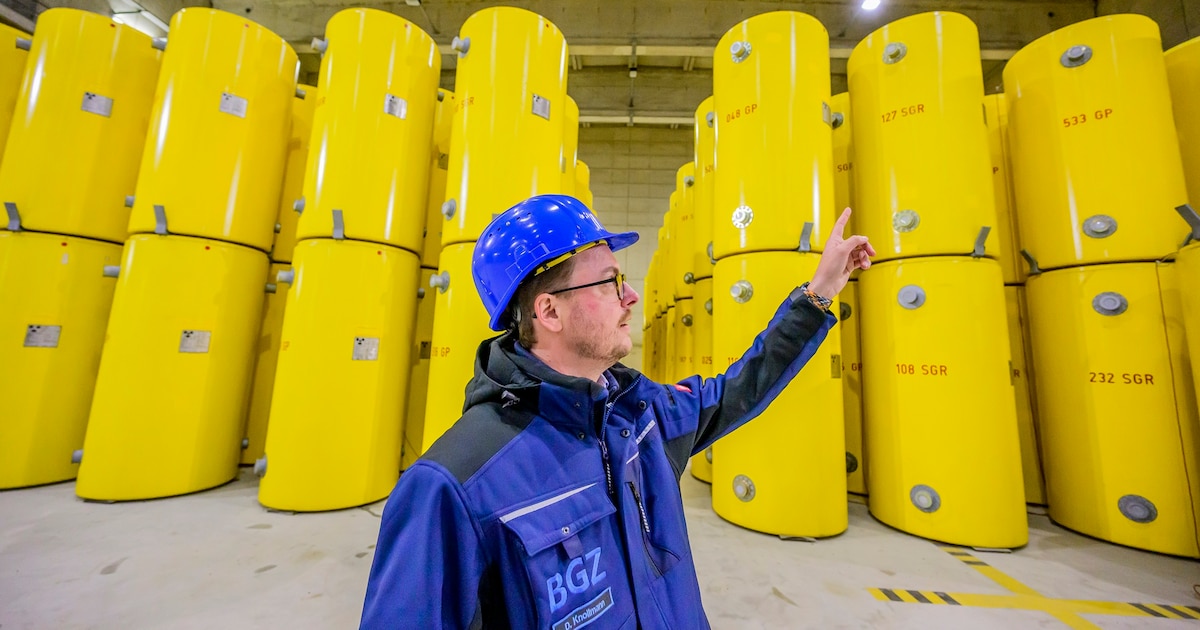
Actually, a location should be found in 2031 to permanently dispose of German nuclear waste. But an internal draft from the Ministry of the Environment distances itself from this date – experts even assume that storage could last until the 22nd century. What’s taking so long?
In addition, there are still nuclear reactors in Germany, just no longer in commercial use. Six research reactors in Stuttgart, Mainz, Ulm, Furtwangen, Munich and Dresden are still in operation. In Gronau in Lower Saxony there is also a plant for enriching uranium to produce fuel rods.
And: A total of 27,000 cubic meters of radioactive waste must be temporarily and permanently stored. Originally, a final repository was supposed to be found by 2031, according to the so-called Site Selection Act (StandAG) from 2017. But experts have long considered the date to be utopian. The responsible Ministry of the Environment seems to agree: the target date of 2031 no longer appears in a draft bill that has been circulating for a few days. A report from 2024 even assumes that the search for a final repository could last until the 2070s. By the time the final storage facilities are filled with all the waste, we could already be writing the 22nd century.
But what is so complicated about the German nuclear phase-out? Three steps still have to be taken before Germany’s nuclear phase-out is actually completed – FOCUS online Earth gives the overview.
1. The dismantling of nuclear power plants
37 commercial nuclear power plants were built in Germany between 1958 and 1982. Only three of them have now been dismantled. The Großwelzheim nuclear power plant, which was only in operation from 1970 to 1971, the Niederaichbach nuclear power plant, which supplied electricity from 1973 to 1974, and the Karlsruhe and Kahl nuclear power plants, which were in operation from 1966 to 1984 and 1962 to 1985, respectively. The former was a research reactor that also fed electricity into the grid. In fact, all three have achieved “greenfield” status. Experts describe this as the successful dismantling of a nuclear power plant. What this means is that from this point onwards buildings and grounds no longer need to be monitored for radioactivity. From then on, they can theoretically be used for other purposes – or as brownfield land.
None of the nuclear power plants shut down after 2011 have yet reached this status. This will also take a long time. Around 15 to 20 years are planned for the dismantling of each power plant. According to current plans, the Unterweser nuclear power plant – which was shut down in 2011 – could be the first to complete it. The year 2031 is planned.
But why is it all taking so long? There are two different areas when dismantling a nuclear power plant. The easiest way is to dispose of all buildings and parts of buildings that have little to do with the actual reactor. “This is completely normal construction rubble,” explains Sven Dokter, press spokesman for the Society for Plant and Reactor Safety (GRS). Then it goes to the radioactively contaminated components. They are divided into three grades.
- Only superficial Radioactive parts can simply be decontaminated and then disposed of like building rubble. These are, for example, pipes through which radioactively contaminated water flowed for years. Over time, a film of radioactive materials builds up on the inside of the pipe. It can be removed, for example, with water or sand blasters and is usually only slightly radioactive. After an inspection, these parts are then released without restrictions.
- Weakly radioactive components can no longer be cleaned this way. However, the radiation they emit is often not too dangerous. Such components receive restricted approval. Metal parts can often be melted down and reused, while other components can be safely added to road surfaces.
- The biggest problem comes from activated components out of. These are mostly those from the reactor itself. Some of them have been exposed to high levels of radiation for decades. Over time, this changes the chemical structure of the atoms in the components, resulting in radioactive substances. They can no longer be cleaned; in the end they have to go to a final storage facility with other highly radioactive elements.
Even if the dismantling of a nuclear power plant takes a long time, it is not a major problem from a technical point of view. “In international comparison, we have a lot of experience with this in Germany,” says Dokter. After all, even before the official nuclear phase-out, 20 reactors in Germany were taken offline. Other countries have also repeatedly shut down and dismantled individual power plants in recent decades.
,regionOfInterest=(2036,1040)&hash=52f314533d6803599f26558916692f18fba1ef1759860d3e570f777ae2422680)
2. The interim storage facilities
During dismantling, radioactive waste is created that will eventually have to go to a final storage facility. The same applies to the spent fuel from around 60 years of nuclear power in Germany. In some cases, the operators sent these to reprocessing plants in La Hague in France and Sellafield in Great Britain. After being used in a reactor, fuel elements still contain fissionable residues uranium and plutonium, which are recovered in these facilities. This creates liquid, highly radioactive waste that is melted down into glass and transported back to Germany.
To this day, all radioactive waste is in interim storage facilities. There is one of these at every old nuclear power plant site, plus two nationwide warehouses in Gorleben in Lower Saxony and Ahaus in North Rhine-Westphalia. The latter two each offer space for 420 Castor containers. “Protection from radiation is essentially guaranteed by the containers,” says Dokter. The storage rooms themselves, however, usually offer little protection against radiation. There are separate storage rooms for weakly radioactive parts, where they remain until they are disposed of.
The name “intermediate storage” already implies that these are not intended to last forever. Originally, the operating licenses for all interim storage facilities were issued for 40 years each. At the central locations in Gorleben and Ahaus they will expire in 2034 and 2036 respectively. As of today, however, it is very likely that the bearings will have to be used for a longer period of time. In terms of safety, this is only a minor problem. After studies, the nuclear waste disposal facility (EWN) has come to the conclusion that the Castor containers are generally safe for longer than 40 years. The official limit was therefore based more on the final repository plans at the time.
The operating license could also be extended accordingly. However, Dokter believes it is impossible that the interim storage facilities will at some point become de facto final storage facilities. “There is worldwide agreement in research that a final repository in deep geological layers is the safest method of safely disposing of highly radioactive waste in the long term.”
There are hardly any alternatives to this. Scientists around the world are researching a method called “transmutation.” Highly radioactive substances from the spent fuel elements are bombarded with neutrons. This causes the original substances to transform into others. Some radioactive isotopes with half-lives of several million years can be eliminated in this way.
Research into transmutation has been taking place since the 1990s. The best idea is to use special breeding reactors for this, because after all, energy is also released during transmutation. However, to date this only works in research reactors. Two Russian reactors can reuse at least parts of fuel rods in this way. Even if it were, that wouldn’t be a solution for spent fuel rods from Germany. The law prohibits the sale of radioactive waste abroad.
3. The final storage facility
So the only solution is to build a final storage facility. There are high requirements for this. The highly radioactive elements must be safely stored here for at least a million years. In addition, a final repository should be designed in such a way that it can be reopened for at least 500 years. Depths of at least 300 meters are considered suitable.
There is currently not a single filled final storage facility for highly radioactive waste in the world. Finland is the closest. In Onkalo, the Finnish power plant operator TVO first built a storage facility for low- to medium-level radioactive waste, then one for high-level radioactive waste. It consists of a series of tunnels that were driven up to 430 meters deep into granite rock. A test filling is currently underway, for which the final containers used are coated with copper. This corrodes extremely slowly and is therefore considered to be particularly durable.
Granite repositories have the disadvantage that the rock is often fissured and therefore not completely waterproof. There is therefore a small chance that radioactive particles will end up in the environment. Finland plans to fill the storage facility with radioactive waste for 100 years and then seal it with the excavated rock and layers of bentonite.
In addition to Finland, Sweden started building the final storage facility in 2022, and France and Switzerland have at least agreed on locations. Germany is not that far yet. Originally, a final storage facility was also supposed to be built at the location of the Gorleben interim storage facility. Construction of an exploratory mine began here in 1986. After long discussions and a ten-year halt to exploration from 2000 to 2010, the Federal Environment Ministry decided to end the Gorleben repository in 2021.
Instead, a new location should now be sought. Theoretically, this is not difficult in Germany. “We have a choice of all three host rocks that are scientifically considered suitable for a final repository,” says Dokter. The first is salt. They have a big advantage: over time, the salt would enclose the final storage containers tightly and tightly. This would make you particularly safe. The second is clay rock. This is also considered extremely waterproof. If the containers here fail after thousands of years, the rock would provide natural protection. Thirdly, there are also crystalline rocks in Germany, which include the granite used in Finland. They are also suitable for final storage, but since the rock is more fissured, the containers would have to be coated with copper, as in Finland.
The legally prescribed deadline of 2031 will be canceled – everyone involved agrees on that. The Bundestag would also have to extend the deadline by law.
If a location is found, construction could begin. Although it is technically comparable to building a mine, it does have some pitfalls. In theory, two shafts are dug to the desired depth and a network of tunnels is then created there. The final storage containers would have to be lowered into this. That alone will take a long time. According to a forecast by the Federal Office for the Safety of Nuclear Waste Management, around 17,000 tons of highly radioactive waste will be generated. This corresponds to around 1,800 containers. If one container were stored every week, all containers would not be stored for another 35 years. If the operator creates two containers per week, it still takes a little more than 17 years.
Once all containers have arrived, the final storage facility must be sealed. To do this, the excavated salt, clay or crystalline is filled in again, with layers of bentonite at intervals to ensure extra safety. Only then would the final nuclear phase-out be achieved.
The time periods make it seem unlikely that middle-aged people living today will live to see this day. The dismantling of the last nuclear power plant will continue until at least 2046. The search for a final storage facility could take just as long. Experience from Finland shows that the construction of a final repository takes another 15 to 25 years. This is followed by several decades for filling. Overall, 2078 would be an optimistic date for the final nuclear phase-out. Pessimistically, it could take well into the 22nd century.
FOCUS online Earth is dedicated to the climate crisis and how to overcome it.
Fact-centered. Well-founded. Constructive. Every Friday as a newsletter.