whizzy1919@gmail.com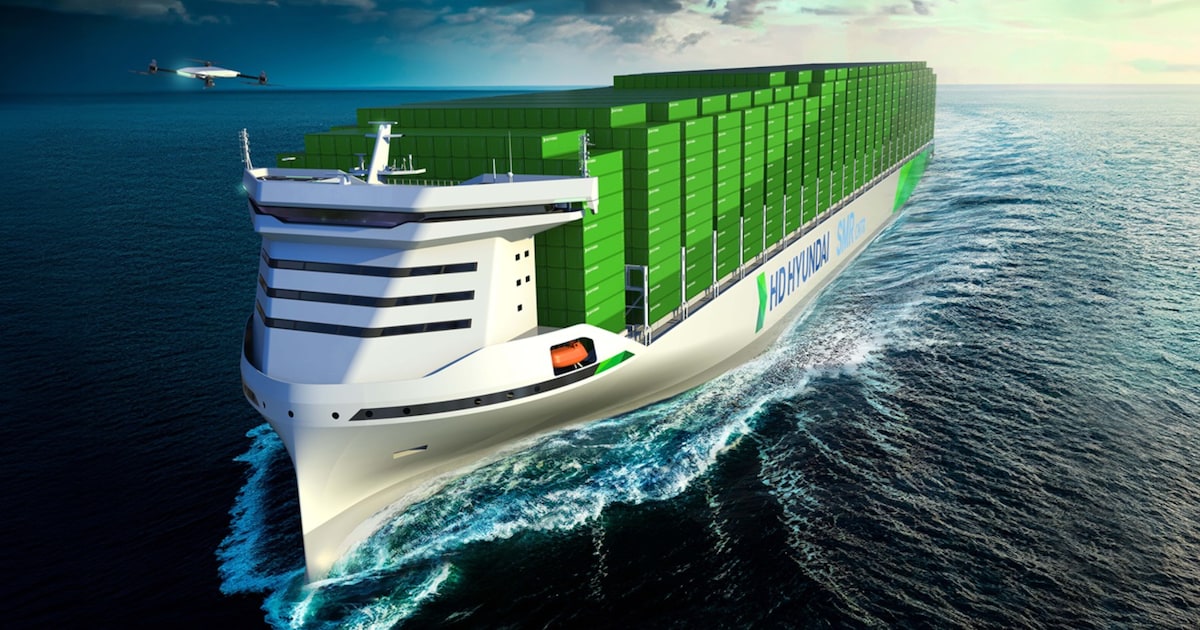
Engineers are planning a cargo ship with an SMR reactor. The mega freighter could run for years – without stopping to refuel and without heavy oil.
In the 1960s, many engineers believed that nuclear reactors would soon power entire merchant fleets. The vision was clear: cargo ships would sail across the oceans for months without ever storing fuel. In fact, only four civilian nuclear cargo ships went into operation worldwide – and almost all of them later disappeared from the world’s oceans. Too expensive, too controversial, too complicated.
Today the idea pops up again. The reason lies in the enormous climate pressure on the industry: International shipping causes around three percent of global greenhouse gas emissions – about as much as a large industrial country. At the same time, global trade in goods continues to grow, and shipping companies are looking for propulsion for long distances across the oceans.
In South Korea, the shipbuilding group HD Hyundai is therefore working on a new concept for a nuclear-powered cargo ship that will move large container freighters across the seas in the future without using fossil fuels.
A nuclear power cargo ship for global trade
The planned container freighter is intended to transport around 15,000 standard containers. This size corresponds to a large modern merchant ship that can travel on important routes worldwide.
The energy comes from a compact nuclear reactor. Experts speak of a Small Modular Reactor (SMR). These reactors are significantly smaller than classic nuclear power plants. This makes them easier to integrate into industrial systems – including a ship.
SMR: Small reactors provide long-term energy
The reactor produces electricity that drives electric motors. The energy goes directly to the ship’s propeller. Complex mechanical gears are no longer required. This reduces energy losses in the drive. The planned output is around 100 megawatts. That corresponds to around 134,000 horsepower.
In the case of a nuclear-powered freighter, most of these systems would be eliminated. The reactor continuously supplies energy without the need for large fuel tanks or complex exhaust gas purification. This creates significantly more usable space inside the ship.
This location can be economically interesting for shipping companies. The space that would be freed up could be used for additional containers, which would increase the possible amount of freight per trip also the economic efficiency of the ship.
The design also provides for two propellers. This so-called twin-screw system works with two propellers instead of just one. This increases thrust and the ship responds more precisely to control commands. Large container freighters in particular benefit from this when maneuvering in narrow harbor entrances or canals.
New drive significantly increases efficiency
In addition to the reactor, the concept relies on additional technology in the power plant system. Instead of steam, highly heated and compressed CO₂ drives the turbines. These generate electricity, which supplies the ship’s electric motor via generators.
The process reduces energy losses when generating electricity. According to the developers, the thermal efficiency can be around five percent higher than with classic steam drives. For large freighters, this means a noticeable improvement in energy consumption and operating costs.
Stable energy for refrigerated containers on board
Refrigerated containers, so-called reefers, are among the largest electricity consumers on a container ship. They keep food, fish, fruit or medication constantly at a low temperature. To do this, they need energy around the clock. On conventional ships, electricity demand increases quickly when many of these containers are loaded.
A nuclear drive, on the other hand, can permanently provide large amounts of energy. This allows a freighter to hold more refrigerated containers.
Security concepts are intended to limit risks
A nuclear reactor at sea requires extensive safety measures. Engineers are therefore planning several protection systems. The concept includes, among other things, radiation protection with a double structure made of stainless steel and water.
This construction is intended to shield radioactive radiation and additionally stabilize the reactor. Possible accidents are also taken into account in the planning. The systems should remain functional even in the event of serious collisions or water intrusion.
The classification society American Bureau of Shipping (ABS) evaluates the design. It awarded a so-called Approval in Principle. This decision confirms the basic technical feasibility. ABS technical director Patrick Ryan said: “Nuclear-powered ships can be a game-changer in the shipbuilding market, where climate neutrality is becoming increasingly important.”
We also see great opportunities within the company itself. Park Sangmin, head of the Green Energy Research Lab at HD Hyundai, said: “We want to develop a business model for nuclear-powered ships by 2030.”
Test facilities should test technology by 2030
In preparation, the company is planning a test facility in Yongin, South Korea. Engineers there want to test the safety and operation of a maritime reactor.
At the same time, the group works with international partners. This includes the energy technology group Baker Hughes. Collaborations with the US company TerraPower are already underway.
Briefly summarized:
- New idea for clean shipping: South Korean engineers are planning a cargo ship with a small nuclear reactor (SMR) that could transport around 15,000 containers and sail for years without stopping to refuel.
- Technical advantage: The reactor delivers around 100 megawatts of power (134,000 hp). Heavy oil tanks and large diesel engines are no longer needed – this creates more space for containers and energy-intensive refrigerated freight.
- Still a long way off: International auditors consider the concept to be fundamentally feasible. The goal is to have a commercial nuclear cargo ship by around 2030.
By Anne Bajrica