whizzy1919@gmail.com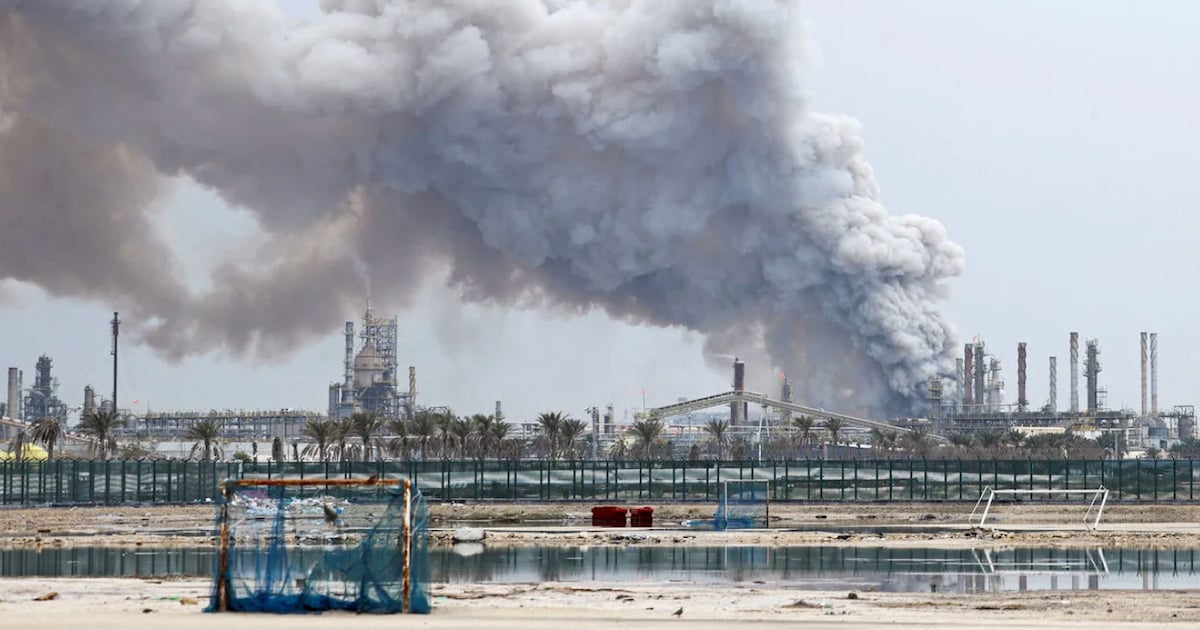
Many investors expect the situation on the energy markets to return to normal by May. But an analysis by The Economist shows that even if the war in Iran were to end today, the consequences would still be felt well into the winter.
The The third Gulf War has now been going on for four weeks. As long as the Strait of Hormuz remains blocked by Iranian attacks on ships, about a fifth of global oil and liquefied natural gas (LNG) production will remain stranded each day. So every day, traders update their estimates of how much supply will be lost for the year. As estimates rise, so do energy prices. At $112 a barrel, Brent crude is 54% higher than before hostilities began. Gas prices in Europe have risen by 85%.
Investors expect energy prices to normalize by May
The reason they aren’t much higher is that investors expect deliveries to start again soon. According to the bank Société Générale, financial bets on falling prices (“put” options) outweigh those expecting an increase (“call” options), for deliveries from July. In other words, taking transportation delays into account, investors expect the situation to return to normal by May.
Even with the Strait of Hormuz open, three factors are needed for the energy markets to recover
For energy markets to recover following the reopening of the Strait of Hormuz, three things must happen. First, producers in the Gulf must return production to pre-war levels. Secondly, ships have to transport these production quantities to refineries abroad. And third, these refineries need to process them into usable fuel. Each phase of this industrial process takes time.
,regionOfInterest=(2037,681)&hash=2f87e5322a5427c62ab9ef5ee4d939afb294d765ef25823d1f5dae66775d8a2d)
Experts estimate that restoring oil production alone takes 2-4 weeks
Let’s start with production. Unable to export and facing storage capacity constraints, Gulf states have already cut their crude oil production by a total of 10 million barrels per day – equivalent to 10% of total global production and 40% of their pre-war levels. To bring these capacities back into operation, producers must check whether everything is still working and clear possible blockages in the pipelines. Only then can they put the boreholes back into operation by restoring the pressure – and do so carefully to avoid damage to the deposits.
It will take additional time to ramp up the separators, compressors and processing plants where the oil is initially processed. Although the Gulf states, as members of OPEC, are used to adjusting output up or down in a matter of days, the latest cuts are more sudden and drastic than anything they have experienced before. Experts estimate that all of this will take between two and four weeks.
The situation at the gas plant in Qatar looks even bleaker
When it comes to gas, things look even bleaker. The Ras Laffan plant in Qatar, which supplies almost a fifth of the world’s LNG needs, has been idle since March 2 following an Iranian drone attack. Last week, two of the plant’s 14 liquefaction units were severely damaged by a missile attack; these represent 17% of their capacity – and 3% of global supply.
The repairs will take three to five years, says Qatar’s energy minister, and a planned expansion will also be delayed. The full extent of damage elsewhere is unclear. But even plants that sustained less damage will likely need weeks of repairs before operations can resume.
The repair is just the beginning. The systems must then be freed of moisture to ensure that the pipes do not crack when they are cooled back down to -160°C. If the process is rushed, the metal contracts unevenly and breaks the welds. Anne-Sophie Corbeau of Columbia University estimates that all of this could take up to seven weeks.
Hormuz backlog could clear up in 2 weeks – but repairs take months
Next comes transportation. In the event of a ceasefire, most captains of the approximately 480 ships stranded in the Gulf would want to wait several days without attacks before attempting to leave the Gulf. Most tankers are already loaded and the strait can handle the heavy traffic, meaning the backlog could be cleared within two weeks. In principle, new ships could then arrive to pick up the production that is gradually starting up again.
In practice, only a few ships are likely to be out of service for many weeks. Iran has attacked port facilities across the Gulf, hitting fuel tanks, warehouses and anchored ships. The terminals appear to be largely intact, although it is possible that some damage has not been disclosed. Sunken ships or infrastructure may need to be salvaged to ensure safe passage, notes John Ollett of Argus Media, an awards reporting agency. Repairs to quays or loading facilities usually take months.
,regionOfInterest=(1024,683)&hash=dc93b8de3c93625d69ba639e4b16a58ce13dd6010de78ff14995463d886c58e8)
Lack of war risk insurance and fear of the Houthis
In addition, most war risk insurance policies in the region were canceled. Insurers that continue to offer cover have increased premiums from 0.2-0.4% of the vessel’s value to 1% or more, with up to 10% being charged for the riskiest voyages. Anyone with internet access can identify the owners or charterers of a ship, making vessels linked to Iran’s enemies a potential target should tensions escalate. Brokers suspect that insurers will not reduce premiums again so quickly.
And even when insurance becomes available – and affordable – again, captains and shipowners may be hesitant. Although Yemen’s Houthi rebels officially ended their two-year campaign against Western-facing ships in the Red Sea last November, only half as many oil tankers (and virtually no LNG tankers) are daring to transit as in 2023, unsure whether they can believe the Iran-backed Houthis.
It will take several weeks for oil facilities to start up again
Further delays will result from the global tanker fleet being in the wrong location. When war broke out, the supertankers that once carried crude oil from the Middle East to Asia began looking for business in the Atlantic. When the Strait of Hormuz reopens, many will choose to complete their current journey — picking up oil in America and delivering it to China — before heading to the Gulf. According to Andrew Wilson from brokerage bsr, the round trip usually takes up to 90 days.
Even if Gulf oil is delayed in reaching far-flung refineries, it will not immediately solve the fuel shortage. Some refineries in China, India, Malaysia and Thailand have shut down entire plants due to a lack of raw materials. Total Asian refinery throughput fell by 3 million barrels per day, or 8%. Once oil returns from the Gulf, it could take a few weeks to get these facilities back up and running.
Emergency shutdowns in particular can take months to reverse, reports Ajay Parmar, a former engineer at TotalEnergies. As with upstream production facilities, several tasks must be completed before downstream refineries can be restarted.
- Every line must be checked and flushed
- The power, steam, cooling water and compressed air systems must be restored
- Processing equipment must be heated slowly to avoid cracking the metal
The same applies to LNG regasification plants.
,regionOfInterest=(3013,1700)&hash=23009afe0c346666526d01bfe1513f334632481856bfa20d6a9a81be1172b9c3)
Global oil production will fall 3% this year
Even if Donald Trump and Iran reach an agreement to end hostilities, it would still take another four months for markets to return to some semblance of normality. Producers in other regions cannot ramp up production quickly enough to make up for previous losses.
The result is that planned global oil production will fall by around 3% this year. For every month that Ras Laffan remains closed, the world loses around 7 million tonnes of LNG – almost 2% of the forecast annual supply. Full capacity will be lower than before due to recent strikes. As a result, even if Qatar were to start producing as much as possible today, production will fall 4% short of demand this year.
The consequences of the energy market shock will be felt well into the winter
The consequences are serious. Global crude oil inventories, expected to be in the lower third of their historical range at the end of March, will continue to shrink weeks after the Strait of Hormuz reopens. If countries with low buffers run out of supplies, this could lead to panic buying and price spikes. Bidding wars for liquefied natural gas (LNG) are just as likely.
The last cargoes from Qatar that left before the closure of the Strait of Hormuz will reach Asia and Europe in a few days, says Ashley Sherman of Vortexa, a ship tracking service. After that, buyers will have to look elsewhere for their supplies or forego them, jeopardizing replenishment of supplies for the winter.
Oil and gas traders continue to bet on a spring miracle. The world prays for it. But even if Trump and the Iranian ayatollahs grant this wish, the logistics of oil and gas will not be easily reassured. The energy markets will have to live with the consequences of the war well into the winter.