whizzy1919@gmail.com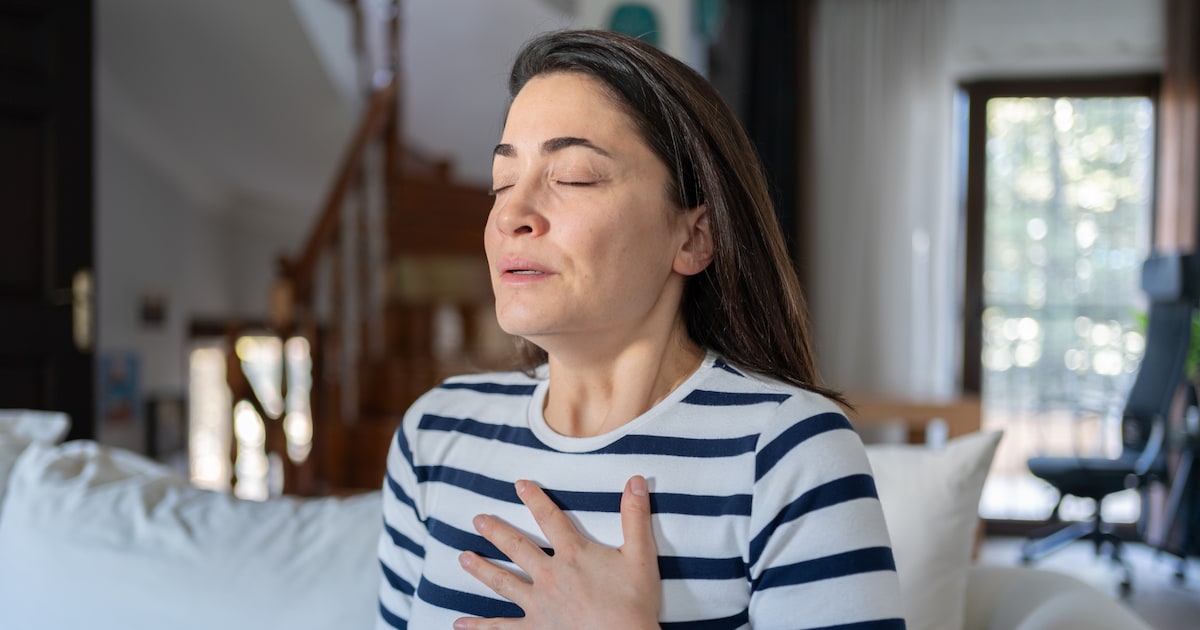
Many people unconsciously hold their breath when scrolling, typing or reading emails. This so-called screen apnea can increase stress – but a simple breathing exercise can help you calm down quickly.
“What’s actually wrong with you?” my partner recently asked me. I was deep in research on my laptop. I’m sorry, what? “You hold your breath for ages and then suddenly exhale loudly and annoyingly.”
Apparently this happened regularly whenever we shared the study. While my partner thought it was intentional and was now saying “Just breathe!” more and more often next to me. shouted, I hadn’t noticed anything until now.
So I started researching and came across a term that describes this strange pattern: screen apnea. are meant short pauses in breathingwhich occur when working, reading emails or scrolling through social media. So maybe you’re holding your breath right now – and, like me, you’re unnoticed, maneuvering yourself into an unhealthy stress spiral.
On the trail of email apnea
Apnea simply means pauses in breathing. Sleep apnea, a sleep disorder, is better knownin which those affected repeatedly stop breathing briefly at night. The lack of oxygen causes all sorts of problems such as sleep disorders and an increased risk of cardiovascular problems.
Something similar happens with screen apnea, at least that’s what articles and blogs keep suggesting, but scientific studies on this are rare. The term goes back to a former Microsoft and Apple manager who had a similar experience to me in 2007. She observed a temporary absence or cessation of breathing while reading and responding to emails. That’s why she initially named the whole thing Email apnealater she expanded the phenomenon to various screen activities.
Subconscious feeling takes your breath away
Can that really be? That working on a screen literally takes our breath away? “There are no hard studies on this, but given the current state of research, the phenomenon could be plausibly derived or understood,” explains psychologist Josef Tatschl when I contacted him in search of answers. At the University of Graz he researches how breath influences health and performance.
Because US researchers around the neuropsychologist Justin Feinstein describe such spontaneous pauses in breathing, for example
- at work,
- at social gatherings,
- when reading emails,
- when using social media
- or when receiving text messages.
What do all of these situations have in common? The part of the brain that processes emotions such as fear, flight and anger reactions is addressed – the so-called amygdala, also known as the amygdala. Feinstein and colleagues therefore gave the whole thing the name amygdala-related apnea.
We are literally suffocating in stress
“When we are exposed to a threatening stimulus, it can activate the amygdala. And if activated sufficiently strongly, it can make us hold our breath without us noticing,” explains Tatschl.
,regionOfInterest=(1359,755)&hash=3108cc461516aa1fdb0622e92bd95744b438faecae2efba795a0201595670a6e)
During the breathing pause, carbon dioxide builds up in the system. “If we were to inhale excessive amounts of carbon dioxide – CO2 – we would quickly experience a very strong feeling of stress, up to and including a full-blown panic attack,” says the researcher. But the amygdala inhibits the receptors in the brain stem that detect excessive CO2 levels. The warning feeling of panic and the urge to breathe do not occur in amygdala-related apnea, so even more CO2 builds up unnoticed.
“Only when amygdala activation subsides and brainstem inhibition is released does chemoreceptive awareness and respiratory drive return,” Feinstein and his colleagues write in their paper. The brain suddenly becomes aware of the increased CO2, causing a “suffocation alarm” and a “state of anxiety characterized by varying degrees of fear and panic, hyperventilation and avoidance and escape behavior.”
Or as my partner would say: extreme and loud breathing suddenly occurs, “like surfacing after a dive.”
So you can get back down in just 60 seconds
Although the acute situation is over, the next problem arises immediately, reports Tatschl. The sudden hyperventilation, i.e. breathing too fast and far too deep, continue to fire up the stress system and prevent you from returning to calm.
“It’s like a stress pendulum that keeps swinging – even though the stressful moment is actually already over,” explains the researcher. The stress itself is less the problem, but rather the inability to get out of it.
According to Tatschl, a short breathing exercise, the so-called “60 seconds of slow-paced breathing” (slow breathing):
- Breathe in through your nose for about four seconds.
- Breathe out through your mouth for about six seconds. Important, says Tatschl: “Don’t squeeze out the air, but rather let it flow out.”
- Repeat this cycle at least six times.
In one study Tatschl and colleagues were able to show that even this short breathing exercise can significantly reduce perceived stress and restless thoughts. In another study They also found evidence that additionally tensing the pelvic floor when inhaling can have positive effects. “The pelvic floor probably acts as a kind of amplifier for the effects that breathing has on the nervous system,” concludes Tatschl.
We breathe around 20,000 times a day
My big conclusion after the conversation with Tatschl: It’s worth paying attention to your own breathing. Because we breathe around 20,000 times a day. Taking time to consciously perceive individual breaths can be exciting. “Our own breathing provides us with a lot of information about our perception and emotions,” says Tatschl. “There are consequences to how we breathe.”
For example, amygdala-related apnea can have long-term consequences if the game is repeated frequently. “This pattern – holding your breath and then overbreathing, hyperventilating to breathe out the carbon dioxide – can disrupt the balance in the body over time,” says Tatschl. For example, affected people could become overly sensitive to fluctuations in carbon dioxide in the blood. “Over time, it can also happen that they acquire a suboptimal breathing pattern, which is then associated with anxiety disorders, for example.”