whizzy1919@gmail.com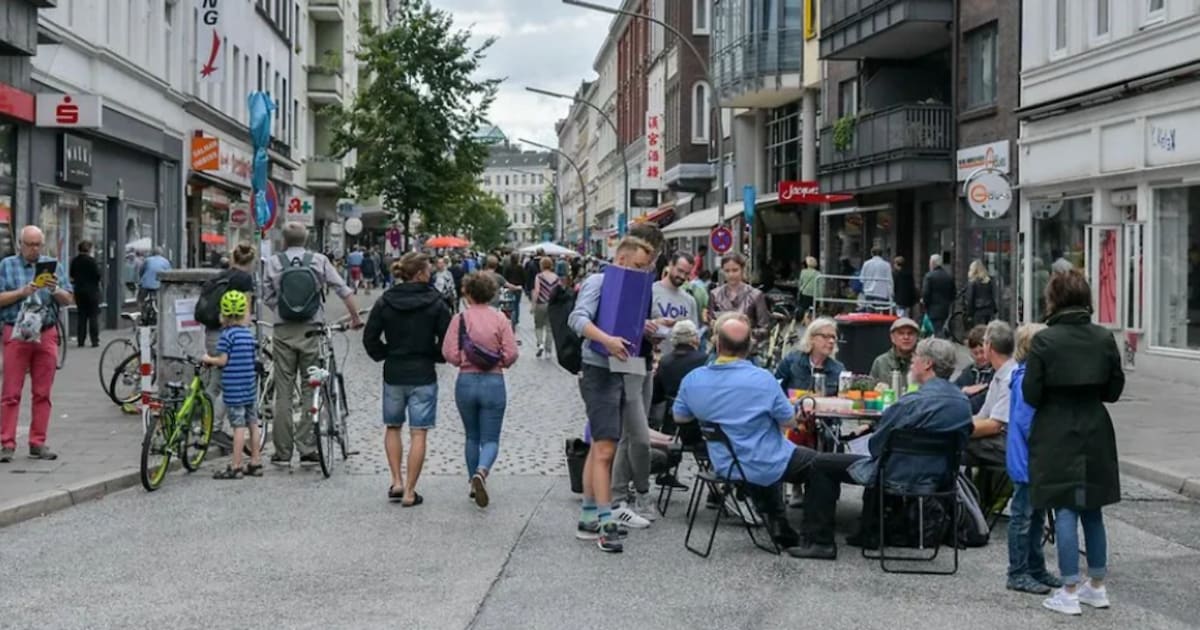
A conversion costing seven million euros is intended to displace cars from parts of the Ottensen district of Hamburg. But unrest and mistrust in the district are growing.
“The district is divided,” said a resident, summing up the mood in Hamburg-Ottensen in November 2019. At this point, cars have been banned from the core of the neighborhood for almost two months. More than six years and many discussions later, the district is now implementing the traffic project in a significantly scaled-down form – and there are still rumblings.
There are comparable examples across the city. The projects are rather small compared to Europe. Why is Hamburg having such a hard time with the transport transition? The problem is often in people’s minds – but sometimes also in the authorities.
Seven million project: Cars should disappear from the Hamburg district
Table tennis and picnics on the street, space for pedestrians and plenty of seating: all of this suddenly seemed possible in September 2019, when the center of Ottensen was declared a car-free zone.
However, it didn’t last long. At the beginning of 2020, the Hamburg Administrative Court granted the urgent applications from two traders. The cars returned to the streets.
The Altona district did not give up and renamed the transport transition project “freiRaum Ottensen”. What followed were six tough years of public participation, workshops, discussions and planning.
Now the seven million euro renovation is actually scheduled to begin in the spring. In parts of Bahrenfelder Straße and Ottenser Hauptstraße, the cars will partially disappear with the help of bollards. These decrease at certain times. Residents of private parking spaces, market feeders and people with severe disabilities will have permanent access.
Distrust and unrest are spreading in the district
But even now the project is still causing unrest and mistrust in the district: at the end of 2024, a business owner left his company headquarters on Bahrenfelder Straße in protest after more than 30 years. The senior citizens’ advisory board is calling for further exceptions for access to the district and fears a new “party mile”.
In the past, transport projects such as “Superbüttel”, which attracted attention across Germany, have caused similar controversy: an initiative called for car-poor residential areas in Eimsbüttel based on the model in Barcelona. So far, only one square has been redesigned, while the planned school street on Rellinger Straße was briefly on the brink due to parking spaces.
The district set up a temporary promenade in Volksdorf in 2022, but there was harsh criticism even before it began, and business owners were worried about their sales. Meanwhile, in the car-poor Pergolenviertel in Winterhude, some residents took to the barricades because of a lack of parking spaces, as did the new development district of Jenfelder Au.
Greens hope for acceptance
“When things change, there is always fear,” says mobility researcher Anne Klein-Hitpaß from the German Institute for Urban Studies. “Change requires adaptation. We are used to functioning in our routines – and when these are disrupted, rejection often occurs at first. However, we underestimate our own ability to adapt. We can very well adapt to new situations and adapt our behavior or our ways.” Acceptance of such traffic tests often comes with time.
Altona’s district leader Sebastian Kloth (Greens) also hopes so. “It turns out that the concerns that are expressed loudly often come from a committed but numerically smaller group,” he says. These would of course be taken seriously. However, surveys have shown that 80 percent of participants fundamentally supported the original Ottenser transport project from 2019.
“A lot of this resistance follows myths to a certain extent,” says Klein-Hitpaß. “Retailers often overestimate how important sales from people driving really are. Traveling by car usually means finding a parking space, detours, effort. Those who come on foot or by bike are more likely to stop for a short time and come more often. At the same time, it shows that where people like to spend time, they are also more likely to spend money.” This applies similarly to the catering industry.
The “Not in my backyard” effect is the paradox of the transport transition
There seems to be a paradox in the transport transition: While, according to a HUK mobility study, 75 percent of Hamburg residents would like to see less car traffic in the city (a national record!), things are completely different when it comes to having your own parking space in front of your front door.
In this regard, experts speak of the “Not in my backyard” effect: fewer cars, but not in my own backyard – or on my street.
“Because we were able to park our cars almost anywhere for a long time – often even for free – parking is quickly being treated like a civil right,” says the mobility researcher. “But a city is not responsible for providing a parking space to everyone.”
Of course, there are always cases with a justified interest, such as craftsmen. Exceptions could be approved for this, for example with craftsman parking spaces.
Large cities like Hamburg have long focused on cars. Only in recent years have the road traffic regulations, originally from imperial times, been revised in this regard. So-called traffic tests, such as temporary speed limit zones, no longer have to be justified by the fact that a particularly dangerous situation exists.
Traffic tests are also possible for climate protection reasons
Nevertheless, this still seems to be the prevailing opinion in some cases: the interior authorities recently rejected a possible traffic calming in the Sternschanze, saying that such attempts could only be carried out “if there is a concrete danger to safety or order in road traffic”. In fact, the law states that such experiments can also take place for climate protection reasons, for example – if they do not endanger road safety.
Concerns in people’s minds and slow processes in the authorities – Altona’s district boss Kloth remains optimistic at “freiRaum Ottensen” despite everything. “The way it is planned now, it can work, and the fact that the renovation is starting now is good,” he says. “It annoys people and me too when something goes on forever and doesn’t come to an end. It will be a major structural intervention, but in the end it will be worth it.”