whizzy1919@gmail.com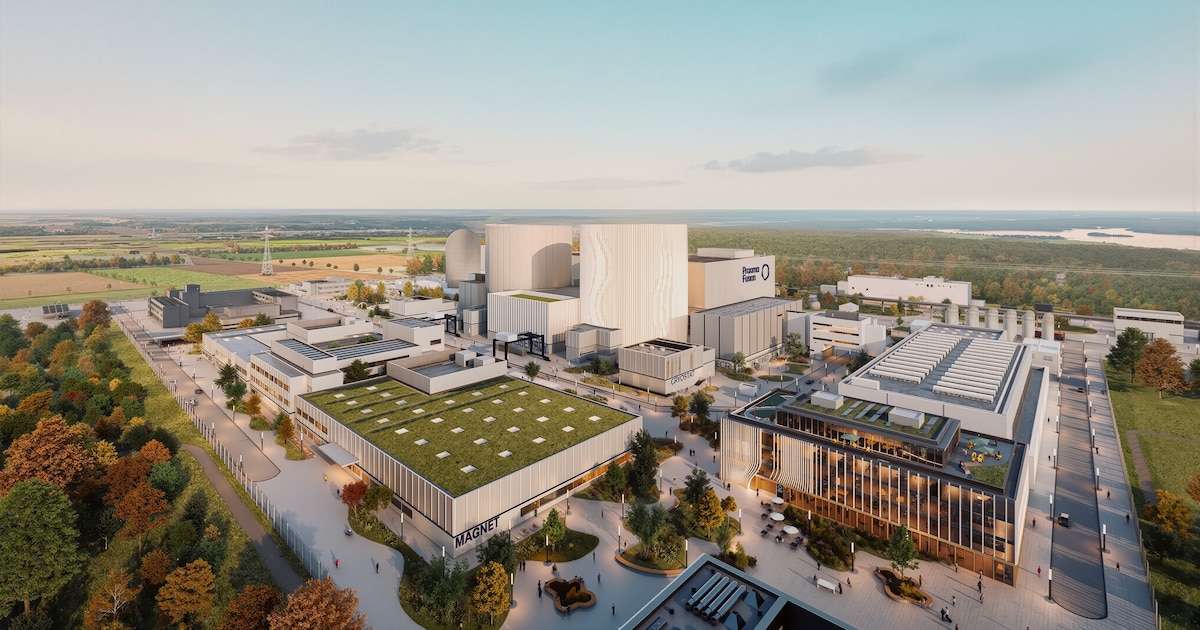
Infinite amounts of clean energy? Nuclear fusion is considered the holy grail of energy supply. In the global race for technology, an exclamation point is now coming from Bavaria.
By the beginning of the 2030s, a research reactor for nuclear fusion is to be built in Garching near Munich for around two billion euros. In Munich, representatives of the Bavarian state government, the Munich start-up Proxima Fusion, the Max Planck Institute for Plasma Physics (IPP) and the DAX group RWE signed a declaration of intent.
The aim: cooperation on the way from the “Alpha” demonstration reactor to the first commercial magnetic fusion power plant at the site of the former Gundremmingen nuclear power plant, around 100 kilometers away. For representatives of the energy industry such as RWE boss Markus Krebber, the project has the potential to be a “game changer”.
“A real show of strength, you have to say that”
“It has to be said that financing this will be a real effort. The ‘Alpha’ project alone will cost two billion euros,” said Bavaria’s Prime Minister Markus Söder (CSU). The Free State will contribute 400 million euros.
At least another 400 million euros are coming from private investors via Proxima Fusion – a large investor conference is currently taking place in Munich to raise money. He very much hopes that the federal government will take on its part for the large national project, which, according to Söder, “necessarily” exceeds one billion euros.
According to Proxima Fusion founder Francesco Sciortino, it’s about nothing less than the opportunity to “build a whole new industry.” The aim is to have the system operational in the next six or seven years. But that requires truly world-class performance.
The “last stone” is still missing
According to RWE, parallel to the “Alpha” project in the immediate vicinity of the Max Planck Institute in Garching, preparations for the later construction of the first commercially usable fusion reactor “Stellaris” will take place in Gundremmingen between Augsburg and Ulm. This should be largely identical to “Alpha” and enable usable energy to be generated using magnetic fusion technology. Nuclear fusion research is being carried out around the world – but so far more energy has to be put into it than is ultimately produced.
Science Minister Markus Blume (CSU) explained that “this last stone” of the financing dimensions had not yet been discussed. In the end, the technology “must then show (…) that you can make money with it on the electricity market and ideally on a large scale, because that is what we need at the end of the day.”
Germany as a global role model?
RWE CEO Markus Krebber was very optimistic that the construction would not ultimately fail due to a lack of money: “If the ‘Alpha’ works,” then not only will the schedule become more solid, but there will also be enough private money available.
The Fusion X Global conference, the world’s largest nuclear fusion industry meeting, is currently taking place in Munich. Bavaria’s efforts in the global race for nuclear fusion do not go unnoticed abroad. “I think they are setting a fantastic example,” says Charlie Baynes-Reid, CFO of the US merger company Type One Energy, to FOCUS online Earth.
Germany is thanks to its strong industrial sector already an important part of the supply chain around the construction of nuclear fusion reactors. “The commitment shown by German industry in general is impressive,” says Baynes-Reid. With projects like “Alpha”, Germany can become a global role model.
Hoping for unlimited electricity
Fusion energy is based on the process of fusion of atomic nuclei, from which the sun and other stars derive their energy. The construction of fusion power plants has been discussed in science since the 1950s. Critics complain, for example, that there is a lack of money for climate protection elsewhere due to the enormous amounts of investment.
For Söder and the other project partners, nuclear fusion offers a completely new technology for base-load, CO2-free and clean electricity in unlimited quantities. The exponential hunger for electricity can be satisfied through electromobility, AI and data centers. RWE boss Krebber also spoke of a “game changer in energy supply”. He called the schedule ambitious but feasible.
SPD irritated by Bayern’s move
However, it is uncertain whether the federal government will contribute part of the financing as hoped. In any case, the SPD appeared irritated by the move from Bavaria on Thursday. The plan leaves “some questions unanswered,” according to a statement from the SPD parliamentary group on Wednesday.
“There is no realistic schedule with concrete technological milestones for a demonstrator,” criticizes SPD politician Holger Mann. “For the SPD parliamentary group, however, this is a necessary prerequisite for a decision on the federal government’s commitment. We expect the Federal Research Ministry to ensure that a national technology agenda does not become a regional government’s location support.”
FOCUS online Earth is dedicated to the climate crisis and how to overcome it.
Fact-centered. Well-founded. Constructive. Every Friday as a newsletter.