whizzy1919@gmail.com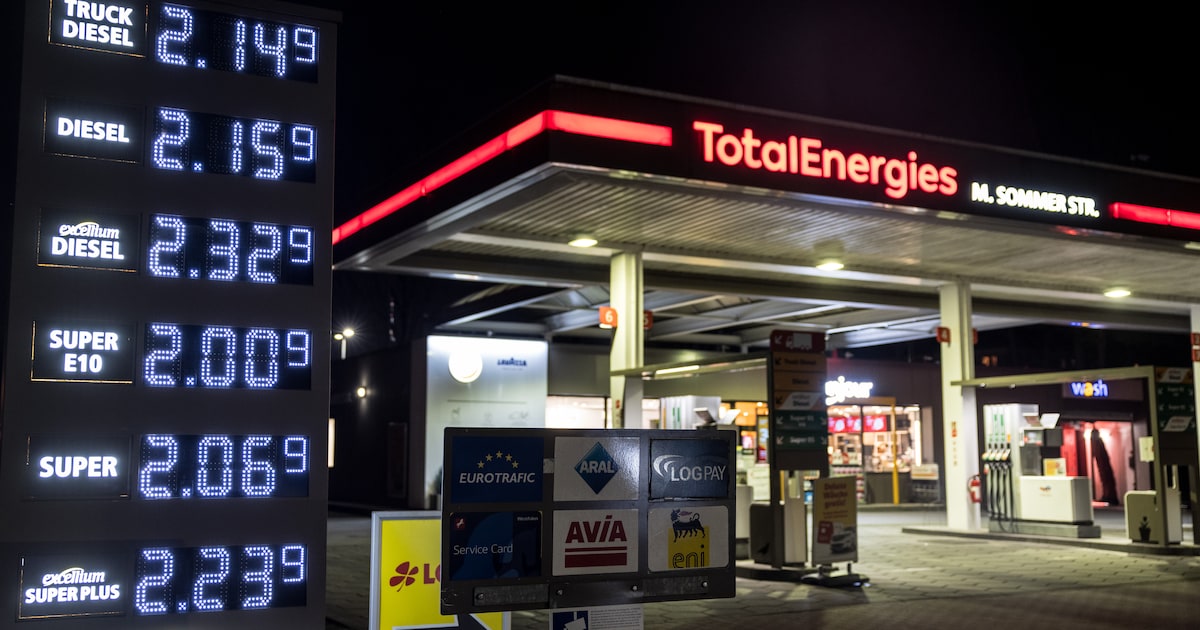
Fuel prices continue to rise unabated in Germany. The state could impose an extra tax on oil companies, as it did in 2022. But politicians and economists are divided.
The oil price is driving up fuel prices and the blockade Strait of Hormuz again the price of oil. Natural gas prices also shot up. In the meantime they had doubled from 30 to 60 euros per megawatt hour at the Dutch trading point TTF. The increase is currently only 42 percent.
Politicians monitor prices at gas stations
The rising prices are a concern for politicians. Federal Minister of Economics Katherina Reiche (CDU) has set up a task force to monitor the situation and suggest measures. One of these measures could be an excess profits tax.
The SPD has recently been open to this. Left-wing parliamentary group leader Heidi Reichinnek is calling for it aggressively: “Even a clear announcement from the federal government that excess profits will be rigorously skimmed off could curb unscrupulous plunder.” The CDU and CSU are still waiting, the Greens would be in favor.
This is an excess profits tax
With one Excess profits tax Special profits that happen to arise due to the world situation are to be skimmed off. It is also intended to be an instrument to ensure that oil companies do not raise prices more than is necessary to maximize their profits.
Technically, it usually functions as a separate tax rate on company profits, which only applies above a certain threshold. To do this, the state must first define what profit is considered “normal”. The tax office will then document everything about this separately.
We introduced excess profits tax for the first time in 1994
Excess profits taxes are nothing new. States introduce them primarily in times of war and crisis. Germany first used an excess profits tax on property owners in 1924 during hyperinflation. We last had such a levy in 2022 and 2023 as the “EU energy crisis contribution”.
Oil, gas, coal and refining companies had to pay 33 percent taxes on all profits during the energy crisis, which exceeded average profits from 2018 to 2021 by at least 20 percent. In addition, electricity producers had to pay 90 percent of their “surplus revenues” to the network operators. The federal government defined such revenue as all profits above a limit per technology. Operators of gas power plants paid different rates than those of nuclear power plants.
That’s how much sense an excess profits tax makes now
The taxes from 2022 and 2023 were surprisingly productive. According to information from the Federal Ministry of Finance from last December, revenue was just under 2.5 billion euros. Previously only around one billion euros had been expected. This is because the energy crisis lasted far longer in these two years than initially expected. This is exactly where the difference lies today.
An excess profits tax only makes sense if a crisis drags on long enough. If the Iran war hypothetically ends tomorrow and oil, gas and fuel prices return to normal within a few days, the cost of levying an excess profits tax will be higher than the return. But if it were certain that the crisis situation would last for the rest of the year, the work of formulating, deciding and collecting such a tax would be worthwhile.
Economists disagree
But even then, many people view them skeptically. Some economists such as Ifo boss Clemens Fuest argue that an excess profits tax is bad because it cannot be planned for companies. Others like DIW boss Marcel Fratzscher are fundamentally in favor of it, but on the condition that the income would be used to relieve the burden on small and medium incomes.