whizzy1919@gmail.com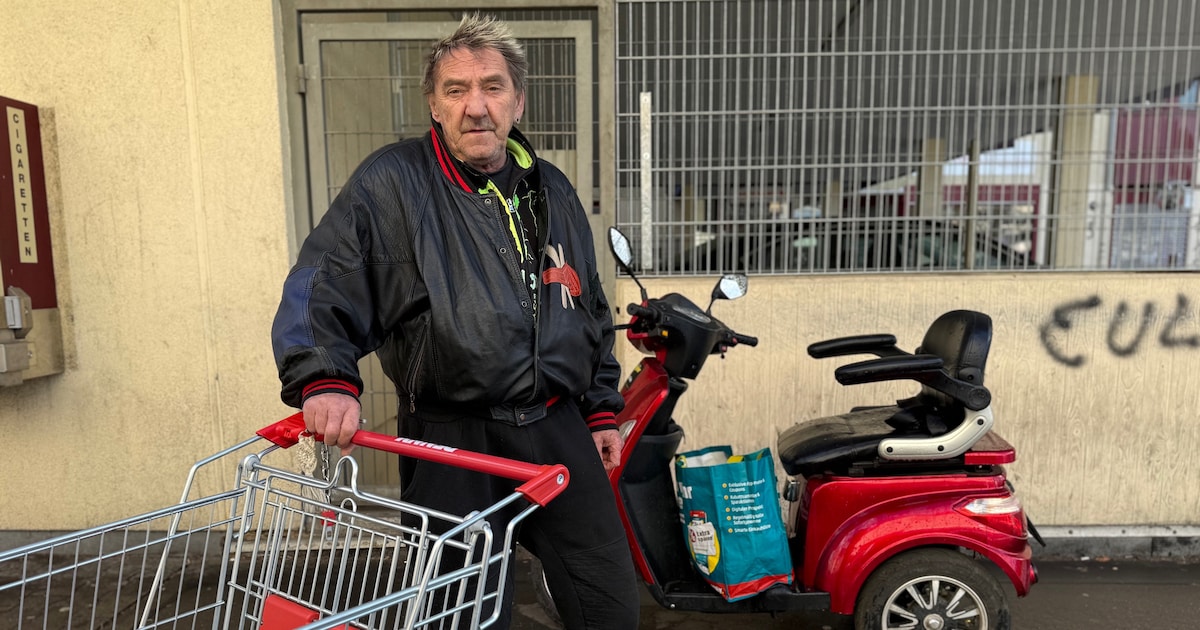
In the state elections in Baden-Württemberg, the AfD got just under 19 percent. She even won the direct mandate in the north of Mannheim. The district is a social hot spot, many people are frustrated and angry (part 1).
The words “Son of a bitch” and “Fuck your mother” are written on the walls, but Viktor now has other things to worry about than daubed facades. The pensioner in the black leather jacket takes fruit, pasta, sausage and milk from the shopping cart in front of the “Penny” market and stacks them in his bag. “Everything has become expensive,” he complains in the broad Electoral Palatinate dialect. “I paid 23 euros for that little bit.”
It hurts. The prices. The dirty area. The private problems. “I was a employed painter. After 40 years of work, I get a pension of 980 euros. I have to pay over 600 euros in rent,” says the 67-year-old from Mannheim. If he didn’t have his wife, things would look even bleaker. “It’s not a life. Just a survival. And that’s difficult.”
Pensioners from Mannheim-Schönau: “No more German bakery”
Viktor was born and raised here, and he will probably die here. Here, that is in the Schönau-Nord district of Mannheim. He himself doesn’t believe that he will experience rosy times again, like before, when “everything was still fine.” He complains about not having enough money and too many foreigners. “They have already taken over almost all the shops. There is no longer a German bakery in the area.”
Actually, something urgently needs to change, says the pensioner. “But the politicians don’t do anything for us. They’ve been in power for years and everything is getting worse,” he says. He has that in the recent state elections in Baden-Württemberg Reacts. “I voted for AfD!”
,regionOfInterest=(1253,686)&hash=fe35b51eb7b8d9730d783269e5222f08a3cf7cd5bdc579ab9480d4d0dfbdb7a7)
AfD candidate wins in Mannheim-Nord – and gets the only Direktmandate
He wasn’t the only one. In the constituency of the dissatisfied man (Mannheim I), the AfD candidate Bernhard Pepperl, a former dentist, won. With 22.3 percent of the first votes, he ended up just ahead of his opponents from the CDU and the Greens. He was the only AfD man to win the direct mandate in the state for the state parliament in Stuttgart and is now one of 35 members of his party there.
But why was a 71-year-old right-wing populist able to prevail in the north of Mannheim who remained colorless or invisible during the election campaign? How is it possible that the AfD man won against two city councilors and an established state parliament member?
Many migrants and unemployed, high levels of child and old age poverty
The former painter Viktor has already given a simple answer before the “Penny”: He lacks trust in the established parties. This also has to do with the conditions in his hometown of Schönau-Nord.
- Of the approximately 9,000 residents, 57.3 percent have a migration history, and for young people under 21 the figure is even 65 percent.
- Around 32 percent are foreigners, most come from Turkey, Poland, Bulgaria and Romania.
- Almost 27 percent of the residents live on state minimum security (citizen’s benefit, basic security in old age), including many pensioners and single parents.
- Almost every second child under the age of 15 lives in a household that receives citizen’s benefit.
- Only around 53 percent of residents of working age have jobs that are subject to social insurance contributions.
- The unemployment rate is 12.3 percent, and it is significantly higher among foreigners.
- 14 percent of the people in Schönau-Nord officially belong to the “precarious environment”.
Schönau-Nord is one of the largest social hotspots in Mannheim
The key figures make Schönau, including the somewhat better-off southern part, one of the largest social hotspots in Mannheim. In the municipality’s social atlas, which sorts the 38 districts according to traffic light colors – from green for “inconspicuous” to red for “conspicuous” – Schönau is traditionally marked in dark red. The area has also recently made a name for itself when it comes to violent crime.
,regionOfInterest=(1567,1117)&hash=9042459888342fc138498b367fe7ee5cbc46d53f22c2b1741ab45aca24d539f4)
Göran Schattauer
On New Year’s Eve there were massive riots at the “Schönau” terminus. Around 20 highly aggressive youths demolished three trams, attacked a driver and smashed the bus shelter. The transport company spoke of “brutal attacks”. Both Mannheim’s mayor Christian Specht (CDU) and politicians from the SPD and Greens condemned the excess.
“Brutal attacks”: Massive riots on New Year’s Eve
But among the population, the act was – once again – seen as a sign that the conditions were becoming increasingly threatening and that the state was powerless to deal with the goings-on. Ultimately, the perpetrators even fired fireworks at police officers and sometimes physically attacked them.
AfD man Bernhard Pepperl fell into exactly this gap during the election campaign. On his website he railed against the increasing uncertainty. In districts like Schönau, “many people experience every day how knife attacks, muggings and clan structures shape everyday life.” Citizens’ sense of security is massively impaired. “Many people hardly dare to go out on the streets in the evening.”
In fact, several residents confirmed in an interview with FOCUS online that they would avoid certain corners out of fear.
,regionOfInterest=(1534,1197)&hash=02f9339699bfb1bdab5220e656470c4ae911832e4a3ef5770f9c9fc28aa9dfd2)
In other areas too, the right-wing extremist denounced the politics that had prevailed for many years. He raged against “high living costs, rising energy prices, dilapidated infrastructure and the consequences of uncontrolled migration.” He identified “a deep crisis of justice” that is “inflaming the mood and eroding trust in the state and politics,” particularly in the working-class districts of Mannheim.
AfD presented itself as the “savior” of Mannheim and Germany
In a way, Pepperl spoke from the soul of his future voter Viktor, the pensioner on the “penny”: “While pensioners with 40 years of contributions collect deposit bottles or can no longer pay heating costs, the city’s social spending is exploding due to unemployment, energy transition costs and high transfer payments.” Pepperl claimed that the AfD was the only force that “can still save” not only Mannheim and Baden-Württemberg, but also the whole of Germany.
Visit to the Schönau-Nord district of Mannheim. Pastel-colored workers’ apartment blocks from the 1950s, 1960s and 1970s, many shrouded in a veil of gray. There are cheap plastic chairs in front of front doors, old car tires and overturned, rusty charcoal grills lie on the lawn. A broken wall mirror rots right next to the sidewalk.
There are no restaurants, shops or cinemas here
Turkish and Eastern European names are stuck on a number of mailboxes. There are no restaurants, shops or cinemas in the area. On the rolled-down shutter of a permanently closed bar, the words “Turk out of the country” are written in incorrect German. Nearby, an older man rummages through bags and boxes at a trash collection point.
,regionOfInterest=(1568,788)&hash=38c2f4b046695cb286dd8f175962be292781a89d7befa6df9ee152a3436ec894)
A woman in her late 60s, who used to work in the office of a large technology company in Mannheim, is standing on the adjacent lawn and smoking a cigarette. Her name is Ulrike and she takes her cat for a walk. She enjoys living here, she says, despite the “bums, drunks and drug addicts that are everywhere here.” The outbreak of violence on New Year’s Eve was not an isolated incident. From time to time there are fights in the district. “It used to be even worse.”
Little money, a lot of poverty: income per person is very low
Everything is just snapshots, everything is just loose impressions and spontaneous conversations. But they tend to confirm the image of a district “with significantly above-average social problems,” as official reports from the city of Mannheim say. The average disposable income per person in Schönau-Nord is 23,700 euros per year. For comparison: at the frontrunner Grünwald in the Munich district it is 89,977 euros, almost four times as much.