whizzy1919@gmail.com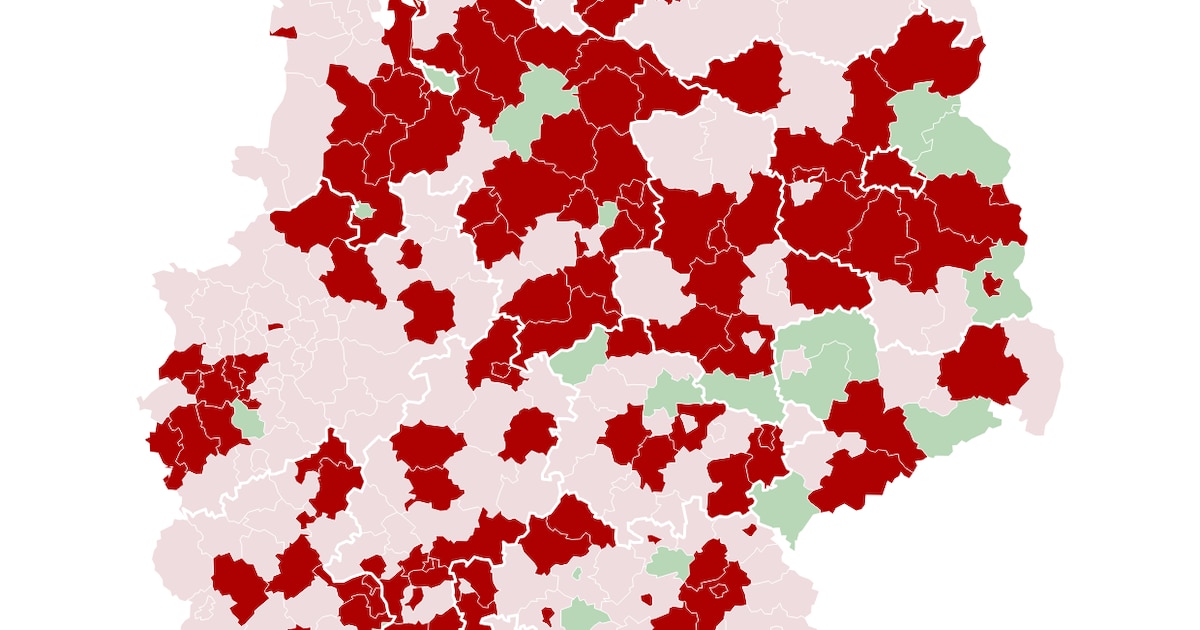
Real estate interest rates are rising rapidly and are breaking the four percent mark again. At the same time, prices are falling in many regions. This can be a trap for buyers. These regions are now tipping over.
Last week, the German Economic Institute in Cologne (IW) published its forecast for real estate price developments in all 400 German regions. In most cases it looks poor. Prices are expected to fall in 158 regions by 2035. Economists expect only minimal growth of a maximum of one percent per year for a further 124. All values are adjusted for inflation. This leaves only 118 regions with moderate to strong growth. The IW defines the latter as at least two percent increase in value per year. This includes places like Cologne, Stuttgart and Berlin.
You can calculate whether buying a property is worth it. On the one hand there are the returns. These are the expected increase in value and the rent saved. The latter also applies if you do not live in the property yourself. In this case you will then receive rent payments. On the other hand are the costs. This includes loan interest, additional costs for buying and selling and maintenance. If the income side is higher than the cost side, then the purchase is worthwhile.
Theoretically, this can also be the case in regions where prices are falling. In practice, this applies to the Vogtlandkreis in Saxony and the Burgenlandkreis in Saxony-Anhalt. By buying a house, you save so much on rent compared to the purchase price that it ultimately compensates for any slightly falling values.
The exact formula explained
The exact formula for the calculation looks like this:
(Debt ratio * interest rate) + maintenance reserve + (incidental purchase costs + additional sales costs) / holding years – gross rental yield
The Debt ratio is 100 percent minus the equity ratio. On average, that’s 80 percent that we expected for our card. The Maintenance reserve depends on the condition of the property. Experts recommend one percent of the purchase value as a good rule of thumb. Additional purchase costs and Incidental sales costs consist of property transfer tax, broker and notary costs as well as the land register entry. The tax varies depending on the state and brokers charge different fees. This usually costs between 10 and 14 percent of the purchase price. The Gross rental yield is the annual rent per square meter divided by the purchase price per square meter.
The problem with the tipping regions
In order for a property purchase to be worthwhile, the result of the above formula must be less than the estimated performance of the property in percent per year. With the average values per region and an equity ratio of 20 percent, this is often the case at the previous interest rate level of two percent. Buying property is worthwhile in 239 of the 400 German regions. This assumes you will hold the property for at least ten years. These include major cities such as Cologne, Düsseldorf, Frankfurt, Stuttgart and Munich.
At today’s level of four percent interest rates, the number of worthwhile regions is falling sharply. Only 37 then meet the criterion of the formula. The major cities include Bremen, Osnabrück, Cologne, Stuttgart and Augsburg. But 202 regions are tipping regions. Here, buying a property at two percent interest rates would still be a good deal, but at four percent it would no longer be a good deal.
In these regions the pendulum is tipping
The major cities below include Kiel, Wolfsburg, Düsseldorf, Aachen, Leverkusen, Wiesbaden, Kassel, Mainz, Munich, Nuremberg, Berlin, Rostock and Magdeburg. However, in many regions this is not obvious. The IW forecasts continued rising real estate prices for 171 of the 202 tipping regions. In some cases it even marks this as “significant”, i.e. beyond the two percent mark per year. This applies to Berlin and numerous districts in Bavaria around the metropolis of Munich. The deceptive thing is that costs in these regions are rising much faster. In order to still be able to buy profitably in Berlin, even with four percent interest rates, you would need an increase in value of at least 2.7 percent per year. This is possible, but relatively unlikely. Only 13 German regions have managed this since the interest rate turnaround. When interest rates rise, prices tend to fall because home sellers want to offset rising financing costs.
The IW predicts a slight to moderate increase in value per year in 162 regions. This means 0.1 to two percent per year, adjusted for inflation. In many regions, buying a house becomes a game of chance. Since the IW expects ranges of one percentage point each, you could, for example, achieve the 1.8 percent return per year required in Flensburg. But it’s also just as possible that you miss them significantly. The IW range here ranges from 1.1 to two percent.
Falling prices are only the problem in 31 tipping regions. These include Neumünster in Schleswig-Holstein, Mönchengladbach and Herne in North Rhine-Westphalia as well as Pirmasens and Kaiserslautern in Rhineland-Palatinate. With a few exceptions, you cannot finance a house profitably anywhere with falling prices and a four percent interest rate on the loan. This is most evident in Neumünster and the Saxon Erzgebirgskreis. There are 1.6 percentage points between claim and reality.
This means you can still finance a house
There are also regions where a purchase would not be financially worthwhile, even with two percent interest. Prominent examples of this are Hamburg, Duisburg, Essen, Bonn, Bochum, Dortmund, Trier, Heidelberg, Mannheim, Dresden, Leipzig and Erfurt. Many holiday regions on the North and Baltic Seas also fall under this category. Here the purchase prices are too far ahead of the rents.
On paper, the easiest way to still buy a property there profitably is with equity. The higher the quota, the more regions are suitable. This is because rising interest rates then play an increasingly smaller role because the loan amounts become smaller. Would you pay for a house entirely in cash?this would be a worthwhile investment in 385 of the 400 regions. With 50 percent equity there are still 165 regions. With an average of 20 percent equity, it is only 37.
If interest rates fall, the number of regions also increases quickly. Even a reduction to 3.5 percent makes 72 regions worthwhile targets. At three percent it would be 113. The last option is to keep a house for as long as possible. In the example, we have calculated for ten years because the IW forecast is only valid for that long. If the price development remains similar afterwards, a long holding period improves. If you keep the property for 20 years, the purchase is worth it in 115 regions. But: Even the forecast up to 2035 is uncertain, after that it will be even more difficult to forecast.
Interest rates double
Since 2022, banks have more than doubled average real estate interest rates. According to the financier Interhyp, from 2015 to mid-2022 they were usually between one and two percent. This has changed with the ECB interest rate change in 2022. Since then, the average interest rate has risen to three to four percent. He is now breaking this higher mark again because of the Iran war and concerns about rising inflation. Banks are currently charging more than four percent for loans with a fixed interest rate of 15 years.
This makes buying a house much more expensive. A loan of 250,000 euros over 25 years would cost you just under 68,000 euros in interest at an interest rate of two percent. At four percent it is more than twice as much at 146,000 euros. If the term remains the same, the monthly rate also increases. This can only be tolerated in three cases:
- If you have a property as Home buy and do not plan to sell them again for a profit. If you can afford the higher monthly payments later and/or are young enough to stretch out the repayment, the purchase will work even with four percent interest.
- If you have a high level of equity can bring in. Ultimately, this reduces the loan amount and with it the interest burden. Around 20 percent equity is common in Germany. If you can contribute 50 percent, the loan will be much easier to manage. You can often get better interest rates from banks.
- If you are buying a property as an investment, but the expected increase in value is higher than the rising interest costs. Then in the end you still make a profit despite higher interest rates. However, this is lower than with an interest rate of just two percent.