whizzy1919@gmail.com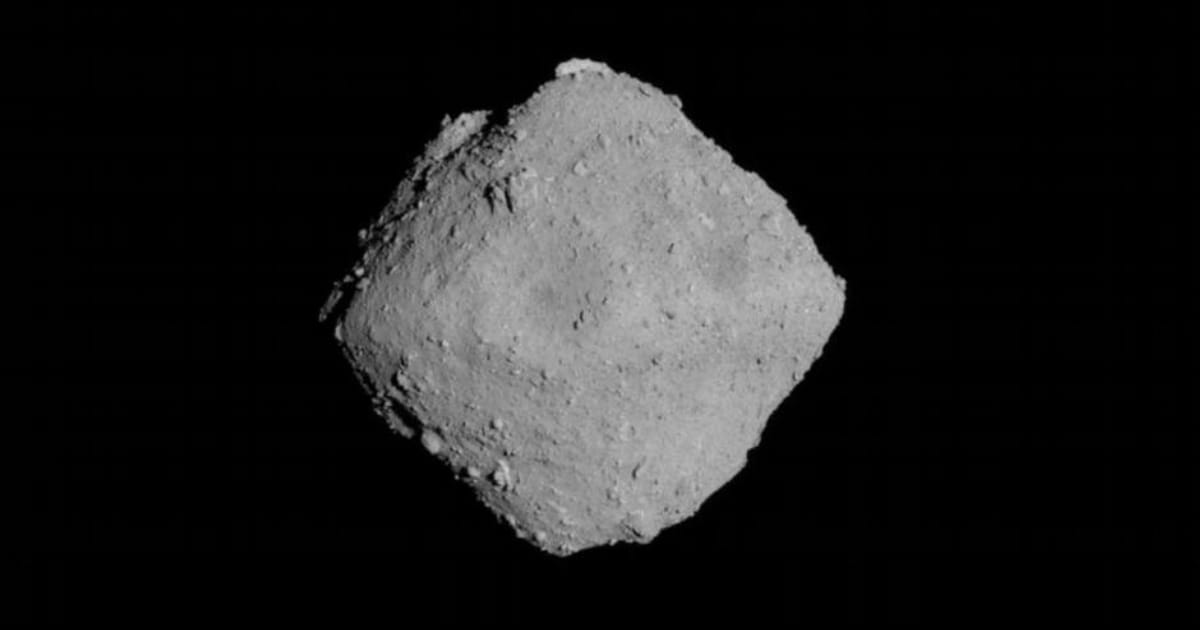
Researchers have detected all the building blocks of genetic material, DNA and RNA, in samples from the asteroid Ryugu – another piece of the puzzle in the search for the origin of life.
It has been fascinating since 1999 Asteroid Ryugu (162173) not just astronomers. The approximately one kilometer wide, angular-looking celestial body is one of the carbon-rich C-type asteroids, the most common class of asteroids in the solar system – and is therefore considered a promising candidate for the search for chemical building blocks from which the first life forms developed.
Samples collected on asteroids
To pursue this, launched the Japanese spacecraft Hayabusa-2 on December 3, 2014 their mission to Ryugu. It collected samples on and beneath the asteroid’s surface, began its return flight in November 2019 and delivered around 5.4 grams of material to South Australia in December 2020. Since then, the samples have been extensively analyzed – and now the first results are available.
The research team led by Toshiki Koga from the Japan Agency for Marine-Earth Science and Technology reports in Nature Astronomy that all central nucleobases were found for the first time in the Ryugu samples – the building blocks that form DNA and RNA and thus the basis of life. In addition to uracil, which was already detected in 2023, adenine, guanine, cytosine and thymine were also found.
However, Toshiki Koga warns against jumping to conclusions: “This does not mean that there was ever life on Ryugu,” he emphasizes. Rather, the find shows “that primitive asteroids were able to produce and preserve molecules that are important for the chemistry surrounding the origin of life.”
The results fit into the puzzle: Nucleobases have already been discovered in material from the asteroid Bennu, which was examined by NASA, as well as in the meteorites Orgueil and Murchison. However, the new study provides the most comprehensive evidence yet of their distribution in the solar system, as systematic comparisons with Bennu, Orgueil and Murchison have been carried out for the first time.
Unexpected chemical signature
Another observation is particularly interesting: the team compared the amounts of different nucleobases in the different space rocks and found that different Asteroids and meteorites contain very different “mixtures” of these genetic building blocks. Ryugu, for example, has an almost balanced ratio of these molecules, while other celestial bodies tend to be dominated by certain types. This shows that each of these bodies has its own chemical history.
In addition, for the first time, a connection was shown between the composition of the nucleobases and the concentration of ammonia in the samples – another chemical important for life.
Why this connection exists is still unclear. But it could point to a previously unknown process through which such building blocks were created very early in the solar system, explains Koga.
Astrobiologist Morgan Cable from the Victoria University of Wellington in New Zealand, who is not involved in the study, calls this finding “unique.” It opens up new perspectives on “how biologically significant molecules may have originally arisen and promoted the emergence of life on Earth.”
Asteroids as cosmic chemistry laboratories
Missions like Hayabusa‑2 and OSIRIS‑REx, which brought samples from asteroid Bennu to Earth, are providing increasing evidence that asteroids functioned as cosmic chemistry laboratories – and may have provided the chemical ingredients for the first life on Earth.
Astrobiologist César Menor-Salván from the University of Alcalá in Spain classifies the findings as follows: Such molecules apparently form easily under prebiotic – i.e. before life existed – conditions, probably “everywhere in the universe”. However, that does not mean that life originated in space, he emphasizes. It is more likely that asteroids provided the organic raw materials from which the first biochemical processes developed on Earth.