whizzy1919@gmail.com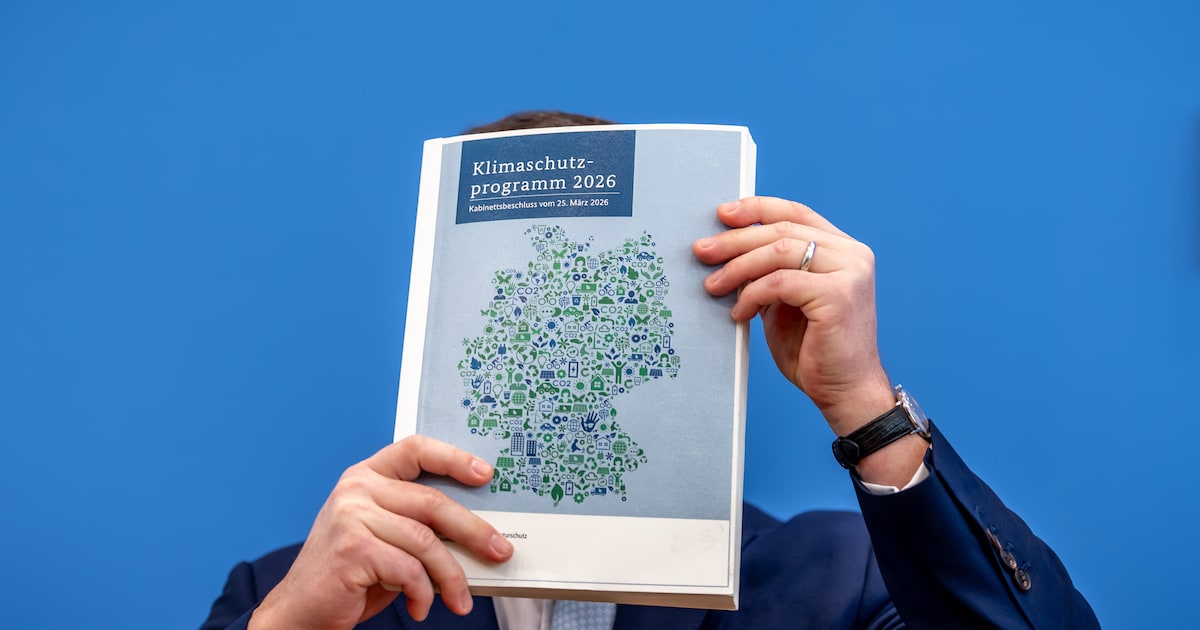
Climate protection has recently stalled in Germany – although the federal government is committed to achieving the climate goals. A new 67-point plan is intended to get the republic back on the right track. But the government’s own experts say: That won’t be enough.
Germany’s climate policy is under pressure. Emissions are only falling slowly, and some measures have been withdrawn under the current federal government. It is obliged by the constitution to protect the climate.
By 2030, Germany must reduce its emissions by 65 percent compared to 1990. However, according to current projections, there is still a gap of around 25 million tonnes of CO2. The federal government now wants to take countermeasures with a new climate protection program: 67 measures are intended to bring the country back on climate change course.
“This program will trigger a new boost for climate protection, which will make us more independent of expensive and unsafe oil and gas imports,” says Environment Minister Carsten Schneider (SPD), whose house developed the program in coordination with the other ministries. “We are making the economy more modern, society more crisis-proof and we are helping nature so that it can help us.”
The program was drawn up “without much controversy,” Schneider added. “The issue of climate protection has become too polarized in recent years. This package can make a contribution to combating polarization.”
Experts: “No overall concept recognizable”
But the dispute could only be beginning now: the government’s own expert council for climate issues is giving the climate protection program a devastating report. The council assumes that the measures taken so far will not be sufficient to meet the climate goals, it said in a statement. The federal government is not meeting its legal obligations with the program.
According to the statement, there are indications that the federal government could “significantly overestimate” the reduction effect of some measures – especially the so-called greenhouse gas quota. In addition, the expert council noted “an overall low level of ambition and innovation” and the measures “do not reveal an overall concept.” The Expert Council for Climate Issues is an independent body that advises the federal government and reviews climate measures.
But what’s in the 67-point plan now? With the new climate protection program, the Union and SPD want to make the energy, transport, industry, buildings, agriculture and nature sectors climate-neutral. This could save seven billion cubic meters of gas and four billion liters of gasoline annually, so the plan should also bring economic benefits. The federal government will provide eight billion euros for implementation by 2030.
1. Energy: More wind, less gas
More wind: An additional 12 gigawatts of onshore wind power are to be tendered – in addition to the 115 gigawatts already planned by 2030. This corresponds to around 2,000 wind turbines that generate as much electricity as 15 to 20 gas power plants.
The result: The additional wind power could significantly reduce the use of natural gas and coal in 2030, saving 6.5 million tons of CO2.
Economic effect: The federal government expects savings of around one billion euros per year on gas imports. At the same time, the price of electricity on the exchange could fall by around 0.6 cents per kilowatt hour. Thanks to comparatively low additional costs, wind expansion is particularly economically efficient.
,regionOfInterest=(242,479)&hash=614366b142e3788233de23c60293fbfb78bcac8cab935f2ba76b137056100304)
2. Industry: Electrification instead of natural gas
Modernization of industry: For industry, the federal government plans to financially support the switch to electricity-powered production facilities and climate-friendly heat such as heat pumps. The aim is for the industry to become more modern and environmentally friendly while at the same time consuming less gas.
The result: By 2030, around 4.3 million tonnes of CO2 could be saved and 2.5 billion cubic meters less natural gas could be imported.
Economic effect: The funding makes the transition easier for companies, reduces their energy costs and makes the industry more climate-friendly and competitive in the long term.
3. Transport: electric cars, charging networks and Germany ticket
The transport sector is considered one of the biggest problem children in German climate protection: for years, too few emissions were saved here because many measures were politically controversial or unpopular. Black and Red now want to take countermeasures with these measures.
More electric cars: The federal government is supporting the purchase of 800,000 electric cars for private individuals who would not be able to afford a new electric car without funding.
Germany ticket: The ticket will be continued and financed in the long term to make public transport more attractive.
Greenhouse gas quota: Fuel providers must reduce their CO2 emissions within the specified quota, for example through biofuels, green hydrogen or electricity for electric cars.
- By 2030, over 800 million liters of gasoline will be saved through the ramp-up of electric cars.
- The Deutschlandticket is expected to reduce one million tons of CO2 per year.
- With the greenhouse quota, the federal government expects 6.3 million tons of CO2 to be saved by 2030 – and a corresponding 2.7 billion liters of gasoline.
Economic effect: The lower gasoline consumption saves consumers and companies money and at the same time makes climate-friendly mobility economically attractive.
,regionOfInterest=(1806,2512)&hash=9f30ffe575af95b1eff1d6f5448e47afa6b72a2f7cae0a51ba327c103274ef9f)
4. Buildings: District heating and heating networks
The building sector is also considered one of the biggest problem children in German climate protection. The controversial heating law introduced by former Economics Minister Robert Habeck was repealed under his successor Katharina Reiche. Black and Red are planning the following measures to decarbonize the building sector, with which Germany is lagging behind.
The heat plans: A new district heating package is intended to expand the heating networks and increase the proportion of renewable energy and waste heat. To this end, federal funding for efficient heating networks (BEW) in the infrastructure and climate neutrality special fund was increased. The funding creates incentives for the construction of new modern heating networks and for the expansion and decarbonization of existing networks.
The results: By using renewable energies and waste heat, around one billion cubic meters of natural gas could be saved by 2030. At the same time, 2.3 million tons of CO2 can be avoided – a significant step towards climate-neutral heat supply.
Economic effects: The expansion of heating networks reduces energy costs in the long term, relieves the burden on households and companies and makes heat supply more sustainable and future-proof.
5. Nature and agriculture: More money for moors and forests
In theory, intact forests, moors and soils are a great lever for effective climate protection because they can bind large amounts of CO2. In practice, however, droughts, forest dieback and soil sealing significantly minimize this factor.
In the agricultural sector, the federal government has plans to reduce emissions – even if only one: They want to support the switch of agricultural machines from diesel to electric drives with a new funding program.
More money for mixed forests: The conversion of vulnerable monocultures into resilient mixed forests should be expanded. Water should be stored better by dismantling drainage ditches.
“Wet farming”: A new funding program is intended to support this special form of agriculture that works on moors and creates new sources of value for moor products. Many moors in Germany have been drained – if they are rewetted, they can turn from a CO2 source into a CO2 storage facility.
+++ Don’t miss any more climate news – subscribe to our WhatsApp channel +++
FOCUS online Earth is dedicated to the climate crisis and how to overcome it.
Fact-centered. Well-founded. Constructive. Every Friday as a newsletter.