whizzy1919@gmail.com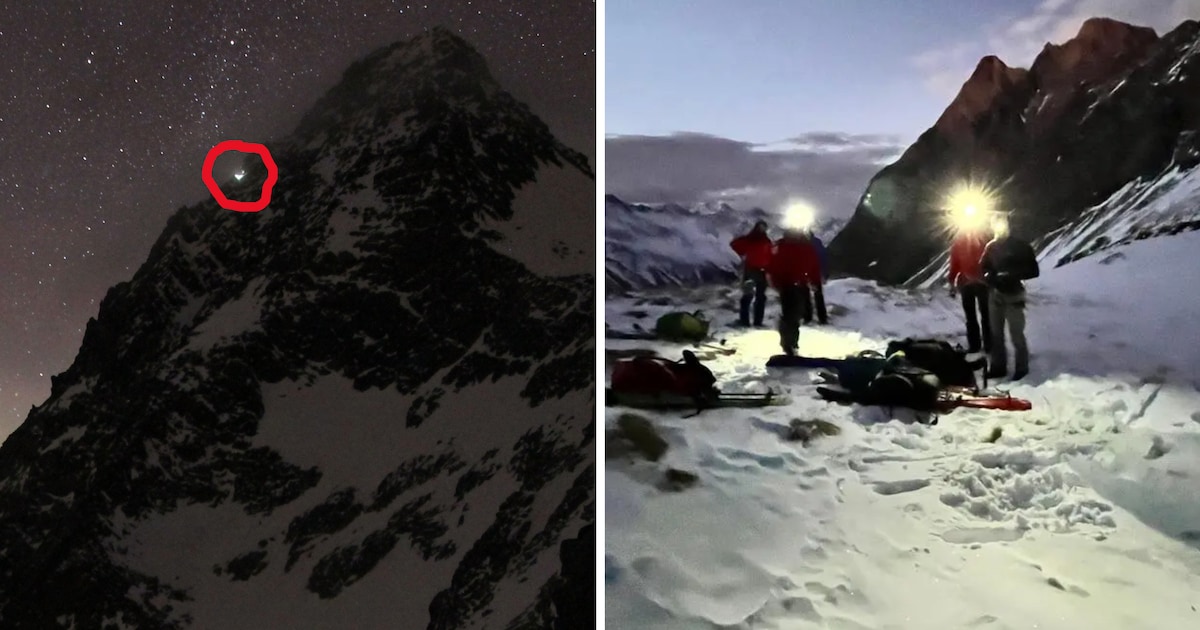
A mountaineer left his exhausted girlfriend alone at the Glockner summit, where she froze to death. The public prosecutor’s office accuses him of “gross negligent homicide”. FOCUS online is at the trial in Innsbruck. The live ticker.
Victim was hanging dangling from a rope
3:05 p.m.: After the lunch break, the witness hearing is briefly interrupted to hear a medical expert. She confirms that Kerstin G. has undoubtedly frozen to death. Judge Hofer had previously described that the victim was found dead on the morning of January 19th about ten meters below a place where the defendant claimed to have secured her to a rock with a rope to protect her from falling. The victim was dangling from a rope.
The judge wants to know from the expert whether it was possible that a person who, according to the defendant’s descriptions, was “so exhausted that he was no longer able to move upright but only on all fours” could have been able to break free from restraint and try to climb down the passage. “I can’t rule it out, but I think it’s unlikely.” She gave the same answer to the defendant’s lawyer when he wanted to know whether she could have freed herself from the restraint and then perhaps fallen.

The defendant is said to have left a friend behind on the mountain
2:14 p.m.: A small bombshell explodes in the trial when Judge Hofer asks the defendant’s brother about the disagreements with his ex-girlfriend. According to Hofer, Thomas P. had already had a similar situation on a mountain with his girlfriend as with Kerstin G.
“Did you know that your brother had a heated argument with his ex-girlfriend when he was out with her at the Glockner in the winter?” The ex-girlfriend is said to have complained heavily about the difficulty of the tour, that gullies were icy, “and at 11 p.m. your brother left his ex-girlfriend alone on the mountain in the pitch black of the night.”
However, the brother denies that he knew anything about it.
Surprisingly, the judge asks about the defendant’s ex-girlfriend
1:45 p.m.: The defendant’s father is questioned as a third witness. He has already been on mountaineering tours with his son.
Judge Hofer surprisingly asks him about one of his son’s ex-girlfriends, with whom he was also traveling in the mountains. “Do you know anything about a massive argument with the ex-girlfriend that she had a grudge against him?” The father confirms that he knew that the son was also traveling alpine with his ex-girlfriend. But I don’t know anything about a “massive argument” or “resentment”. The judge does not explain the background to the question any further.
Now the mother of the dead friend is being questioned
12:47 p.m.: Now the taking of evidence begins. Judge Hofer’s first witness is the mother of the 33-year-old who froze to death.
He wants to know whether the daughter had already gone on winter tours before the Glockner tour. The mother denies that.
She first mentioned in spring 2024 that she wanted to go to the Großglockner. She only spoke about the specific date on the evening before the tour.
The mother doesn’t know whether her daughter knew the Alpine emergency number. The judge had already mentioned that Kerstin Stüdlgrat had dialed the number 149 on her cell phone shortly before 6 p.m. However, the Alpine emergency number is 140.
“Go, go alone and save your own life,” the girlfriend is said to have shouted
12:18 p.m.: Thomas P. tells how he and Kerstin ended up staying at around 2 a.m. He answers the question of why P. didn’t call the Alpine police again as follows:
“It was an absolutely exceptional situation. Kerstin had no strength, I fixed her to the rock with a rope and then got off.”
When he then turned back to her because he had apparently had doubts, she shouted loudly at him: “Go, go alone and save your own life.”
Judge Hofer states that he cannot understand at all why P. did not call the Alpine police again at that moment.
“The tea was frozen and Kerstin collapsed”
11:58 a.m.: Now Judge Hofer is questioning the defendant about one of the most sensitive moments of the tour – the alleged emergency call that P. claims to have made at 12:35 a.m.
P. describes how after his girlfriend’s physical condition deteriorated significantly. They would have wanted to fortify themselves with tea. “But the tea was frozen, so Kerstin collapsed,” says Thomas P.
The police officer on the phone told them to stay warm and keep moving.
Defendant explains the long delays in the ascent
11:39 a.m.: The defendant is now questioned in detail by the judge about how the tour went. Thomas P. explains the delays of several hours by saying that they wanted to go “deliberately slowly” because they had a long tour ahead of them. The plan was to start around 7 a.m. They wanted to be at the summit by 9 p.m.
The defendant reports that Kerstin slipped and fell two or three meters at a point above the so-called “Breakfast Place”, from which it is no longer possible to return. She injured her right hand and a rib and lost a glove. That took her 20 minutes.
Previously, P. describes, they had lost an hour and a half at one point because the rope got jammed while climbing up.
When asked why he and Kerstin did not signal the helicopter that hovered over the climbers at 10:30 p.m., the defendant said: “When Kerstin was up at the safety stand with me, I asked her if everything was okay and whether she had called the mountain rescue service. She told me that she was fine and that she had not called the mountain rescue service.”
Shortly afterwards, his girlfriend had an unexpected attack of physical weakness.
10:05 a.m.: First big surprise: When the judge asked whether Thomas P. had prepared and led the tour, the defendant replied that there was no guide relationship. “But that is a key question for the prosecution. You testified at an earlier point in time that you had planned and led the tour.” The 37-year-old from Salzburg then replies: “I can’t remember that statement.” The question is fundamental, because the public prosecutor’s office accuses P. of disregarding the duties that resulted from the so-called “leading as a favor” in nine cases.
Accused mountaineer speaks and describes the tragic night
9:56 a.m.: Now the defendant speaks. He explains: “I am incredibly sorry for what happened and how.” After 10:30 p.m., when the rescue helicopter turned away without having accomplished anything, his girlfriend experienced a sudden drop in performance. “The call to the Alpine police at 12:35 a.m. was an emergency call,” he says. There were misunderstandings because there was strong wind. Kerstin no longer had any strength, and he himself was no longer feeling well. “We need helicopters, I told the police. They replied that the helicopter could no longer fly because of the strong wind.” He and Kerstin then “decided together” that he would go down to the Erzherzog-Johann-Hütte at 2 a.m.
9:21 a.m.: In addition, the defendant “should have made an emergency call by nightfall at the latest” and ensured that communication with the emergency services was maintained. When he left Kerstin G. alone at the summit at 2 a.m., he left her defenseless in the freezing weather conditions.
9:19 a.m.: The public prosecutor’s office accuses the defendant of having undertaken an alpine high tour “given his girlfriend’s inexperience” that she had never done before of this length, level of difficulty and altitude. In addition, the tour was scheduled “two hours late”.
The defendant also did not expect an “emergency of any kind,” which is why he did not have “sufficient bivouac equipment.” Furthermore, he did not prepare his girlfriend for “climbing with crampons in mixed terrain” and had him wear a splitboard and soft boots that were not suitable for crampons.
Trial for accused mountaineer begins
9.15 a.m.: The process begins! The single judge Norbert Hofer made a preliminary remark at the opening of the trial: “There was a lot of discussion in the run-up to the trial as to whether I am able, you know that I am a mountain rescuer, also an emergency paramedic in Bergen. But I see myself absolutely in this position, 100 percent, to make an objective decision, otherwise I would have declared myself biased.”
8.25 a.m.: In the event of an application for bias, the President of the Regional Court must decide. If the court president is unable to attend, the decision can be made by the individual judge concerned during the hearing. This decision can be subsequently appealed to the Higher Regional Court, a spokesman for the regional court said.
8:07 a.m.: Theoretically, all those involved in the proceedings can file a motion to exclude the judge because of his work as a mountain rescuer. However, according to the court, the fact that a judge is a mountain rescuer is not enough to cast doubt on his impartiality.
Grossglockner Trial: Trial scheduled for one day, but extension possible
8:04 a.m.: There is already a dense crowd in front of the courtroom at the Innsbruck regional court. Around 50 journalists from home and abroad have registered. After almost a year of investigation, the regional court initially set a day for the trial.
But since 15 witnesses, including several mountain rescuers and experts, are being heard, an extension is certainly possible, a court spokeswoman told FOCUS online on site. Single judge Norbert Hofer presides over the trial. Hofer is officially an expert in mountain, avalanche, climbing, cable car and skiing accidents.

Thursday, February 19, 2026, 6:00 a.m.: The trial is scheduled to begin on Thursday at 9 a.m. at the Innsbruck regional court. FOCUS online will then be there live.
The most important details you should know in advance
More than 200 people have already lost their lives on the Großglockner, but not a single case has so far caused nearly as much of a stir. Even the New York Times has now reported on it. According to the Viennese “Standard”, a Texan songwriter is said to have dedicated a song to the fatal mountain drama, and hobby detectives are speculating in the depths of the Internet about the dark background to the accident.
• On January 19, 2025, the completely exhausted 33-year-old Kerstin G. froze to death 50 meters below the summit of the Großglockner after her boyfriend Thomas P. (36) left her there alone at 2 a.m.
• The now 37-year-old was charged by the public prosecutor with “gross negligent homicide”. As a much more experienced mountaineer, he was given “leadership as a favor”.
• The prosecution places Thomas P. nine errors to blame: These include: poor tour preparation with regard to time, equipment and weather, not turning back, failing to call emergency services in a timely manner and leaving his girlfriend unprotected in strong gusts of wind and minus 8 degrees.
• On a webcam portal you can follow the glow of the tragic mountaineering duo’s headlamps below the Glockner summit.
• Kurt Jelinek, the defendant’s lawyer, continued to speak of a “tragic accident” until the trial began.
• If convicted, the Salzburg mountaineer could face up to three years in prison.