whizzy1919@gmail.com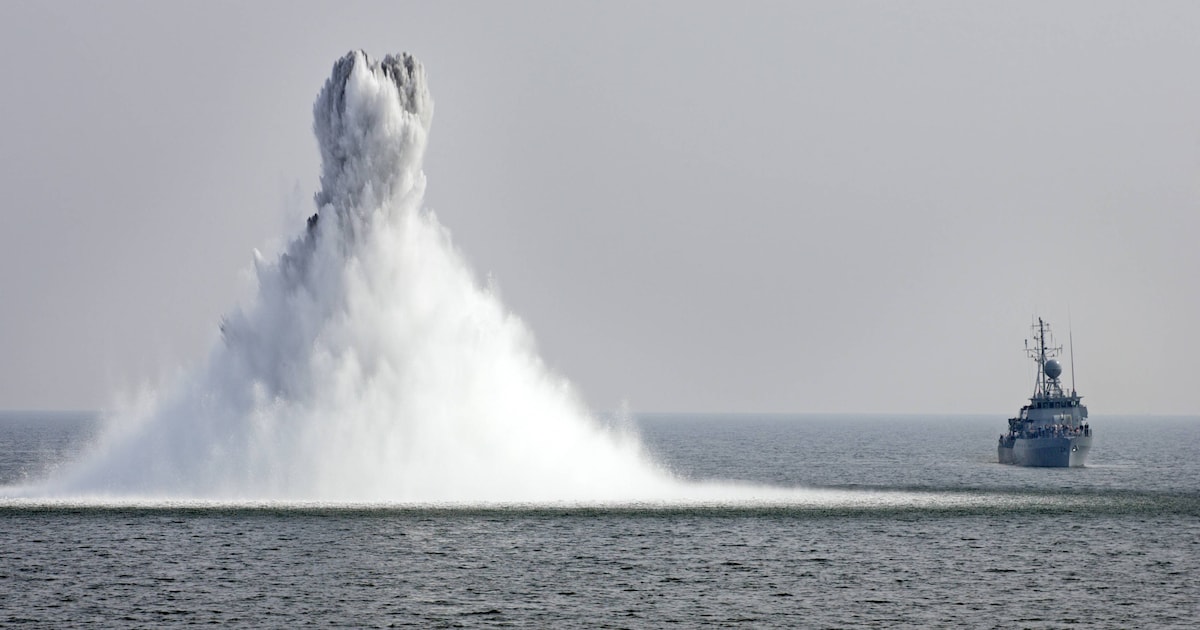
Defense technology specialist Dorothee Frank analyzes Iran’s sea mine arsenal, massive gaps in US mine defense and explains why the German Frankenthal class could become a decisive option in the Persian Gulf.
Three factors make this happen Strait of Hormuz currently a dead zone for merchant ships: Sea mines, drones and missiles, i.e. rockets or long-range artillery. With a width of just 55 kilometers at its narrowest points, this important shipping route is a bottleneck that is easily controlled by Iran.
They are a particular threat Mines. They are a danger that cannot be countered by any merchant ship or even by a few navies.
Iran’s naval mine arsenal: Maham-2 and Sadaf-2
There are divided opinions about exactly how many mines Iran has. What is certain, however, is that Iran has large reserves, up to 2,000, of sea mines Maham-2 owns. This has acoustic and magnetic sensors and is stationed on the seabed at a depth of ten to fifty meters. Its warhead contains around 350 kilograms of mass.
In addition, Iran probably has several thousand simple anchor mines Type Sadaf-2which swim just below the surface of the water and are triggered by contact. The warhead of this mine weighs about 100 kilograms.
USA: Deficits in mine countermeasures and mine hunting
The USA has so far only been able to deploy an actual minesweeper into the area, which is mainly due to the fact that ships are rather slow to deploy and take a corresponding amount of time.
For this reason, necessary maritime units are usually moved forward, i.e. already stationed near the future location of deployment, which is what the USA did, for example, with its aircraft carriers. But the danger of Operation Epic Fury to civilian shipping in the Strait of Hormuz had apparently been underestimated.
,regionOfInterest=(4317,1917)&hash=147f1e201c1e25681f0819c83c68e14d90b051231318b770617f386f16afa4a0)
Threat from Iranian Shahed drones and guided missiles
In addition to the mines, there is still a danger from drones and missiles, both of which can also pose a serious threat to a merchant ship; even if one Shahed drone can “only” carry an explosive charge of around 60 kilograms (the torpedo that made the battleship Bismarck unable to maneuver during the Second World War did not have much more explosive power). As soon as the steering or propulsion is damaged and a ship can no longer maneuver, a merchant ship then becomes a floating barrier that endangers other ships.
,regionOfInterest=(996,436)&hash=42d9b9d77b1ca6d6522497610031f6f403c38b80679cbf6d4ec35548b0440e87)
Rockets and guided missiles and long-range artillery remain a third threat to civilian ships. All three weapons can potentially affect merchant ships due to the narrow width of the Strait of Hormuz.
Why mines pose the greatest danger
Of these three dangers, mines currently remain the greatest because they are the hardest to ward off and detect, but at the same time they are cheap to produce and easy to lay.
While most warships also have the means to detect and counter drones and missiles, the capabilities to detect modern mines such as the Maham-2 are not sufficient to clear an area for shipping. Mine detection and mine hunting remain the task of specialized ships. And they would have to be on site first.
German minehunting capabilities: the Frankenthal class
How many mines Iran has already laid or has still stored ready to be laid is unknown, making the area an incalculable danger.
Although Germany has appropriate minehunting capabilities; the German Navy has a total of ten Frankenthal-class ships, but Defense Minister Boris Pistorius ruled out the use of German warships in the Strait of Hormuz. “It is not our war,” emphasized the German Defense Minister.
,regionOfInterest=(678,699)&hash=988e24133b66bde9c51d285f33b7a7654ea5ca3092b89bb3fa4c4bae850dc51e)
Dorothee Frank began her journalistic career over 20 years ago as a trainee at Authorities mirrorwhere she moved to the defense technology department following her traineeship. Since then, she has been writing about defense and military technology through various positions in national specialist publishers, currently as editor-in-chief of Defense Network. As a specialist journalist, she visits troops and trade fairs at home and abroad and in recent months has also traveled to Ukraine and Israel, among other places, to find out about developments.