whizzy1919@gmail.com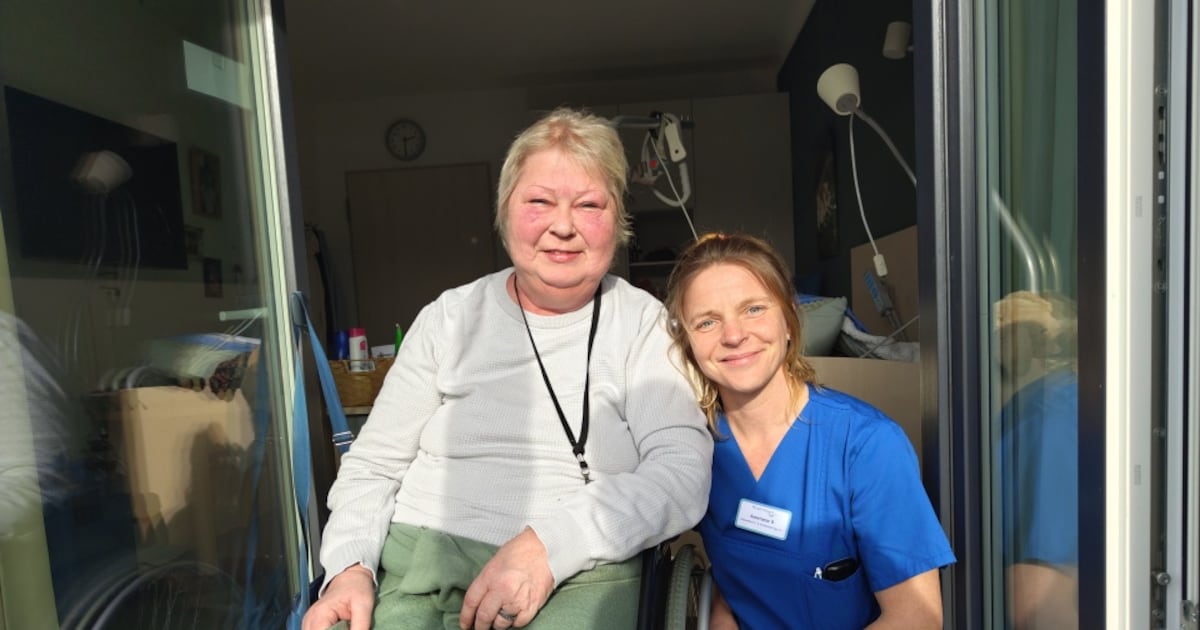
Marita Heinrich has terminal lung cancer. She lives in a Berlin hospice. What is important to her in the rest of her life?
The sun shines so brightly that Marita Heinrich has to squint her eyes. Still, she’s been sitting outside for hours. Only in the entrance area of Orchideenweg 77 in Berlin-Neukölln. Then on her balcony. “I never used to look at the sky. Now I do it every day,” she says.
It’s the first warm day of the year. It’s a pleasant 16 degrees Celsius outside. Marita Heinrich, 61 years old, thin, gray-blond hair, light blue eyes, wearing a light gray sweater, lights a cigarette on the balcony of her room in the Ricam Hospice.
Heinrich has terminal lung cancer. She doesn’t like to talk about her illness. Instead, she takes a drag on her cigarette and smiles. “You know, I take each day as it comes. Today is a good day.”
Heinrich received her diagnosis in November 2024
According to estimates by the Robert Koch Institute (RKI) 58,300 people are diagnosed with lung cancer every year. In 2023 there were around 33,500 men and 24,900 women. As the German Cancer Aid writes, the average age of onset is 70 years.
Marita Heinrich received her diagnosis in November 2024. She was 59 years old. She still remembers that day clearly. “I was working, then shopping and walking the dog outside. At home I suddenly had an epileptic seizure.”
She was examined thoroughly in the hospital. “Then came the shock,” says Heinrich. Lung cancer. At first the trained butcher didn’t want to admit it. From one moment to the next she was seriously ill.
She went home and continued as usual. Working, household, dog. She noticed that something was wrong with her body. That she was quickly “out of breath”.
“Chemo doesn’t just destroy you”
Heinrich only went to chemotherapy for a short time. After a few weeks she stopped the treatment. “My family cried,” she says in broad Berliner. Her relatives probably still hoped that she would get well again. This is how Heinrich explains the reaction.
The woman in the gray sweater has two children, a son and a daughter, as well as a grandson and a granddaughter. Their children come to Orchideenweg 77 every Saturday. Their grandchildren are often there too. Then they chat, go outside or eat together.
For Heinrich, it’s the moments that count. She didn’t stop chemo just for herself, says the woman with bright blue eyes. “This kind of therapy also destroys your relatives.”
In front of the 61-year-old there is a chair with an ashtray on it. She leans forward. Smolder residue trickles into the container. The brake on her wheelchair prevents Heinrich from moving forward. It’s a pragmatic arrangement.
This is how Heinrich came to the Ricam Hospice
The Ricam Hospice is small. There is a day hospice and an inpatient area. Seriously ill people who still live at home and want to receive soothing therapies can come to the day hospice.
The inpatient hospice has ten places. It is aimed “at the very individual needs of terminally ill people with a short life expectancy and severe symptoms of illness”. it says on the website. Marita Heinrich is one of these people.
She came here just a few months after her diagnosis. That was the beginning of 2025. When she entered the building for the first time, the 61-year-old was very afraid. “I thought: That’s it. This is the final stop.”
Heinrich now calls the Ricam Hospice her home. She likes the caregivers, the contact with other guests and the security that medication and an emergency button give her.
Her room is plain. She brought little with her from home. There are a few pictures of her relatives and her dog, a ten-year-old golden retriever, hanging on the wall. The room shows how Heinrich thinks and lives today. Everything is reduced to the essentials.
She enjoys time with her family. That’s the most important thing in life, says Heinrich, narrowing his eyes. The sun shines directly into her face. She didn’t always see it that way. Or at least not always lived it.
The nurse: Konstanze Bogatzki
“I was in the daily grind. Getting up, working, dressing everything up. Earning more and more money. All nonsense from today’s perspective,” says Heinrich. The 61-year-old had many jobs. Worked as a butcher, in geriatric care, at the food bank, and most recently as a cleaner.
Konstanze Bogatzki sits next to her on the balcony. She has been working at Orchideenweg 77 since 2020. The nurse has tied her ash-blond hair into a ponytail. A few strands fall into her face. Bogatzki wears a bright blue shirt, her eyes are almost as blue, big and friendly.
The nurse has known Heinrich since she moved in around a year ago. Many guests, i.e. hospice residents, like to talk to her, she says. “Sometimes I wonder if this isn’t too tiring for you, Marita. But you have to know that for yourself.” Heinrich smiles.
A butterfly for every guest
Sister Bogatzki stands at the foot of a staircase. The wall to her left is covered in butterflies. Red, green, blue, pink. It looks like a huge swarm is sitting on the white wallpaper. “Every butterfly represents a deceased guest,” says the 42-year-old.

In the Orchideenweg it’s like this: Anyone who comes to the hospice can choose a plastic butterfly. He then accompanies the resident until the end. “Everyone leaves a trace,” says Bogatzki.
Anyone who looks at the swarm has two thoughts. A warm culture of remembrance is lived here, is one thing. The other: A lot of people who are no longer there and who their relatives, friends and acquaintances can only remember.
Bogatzki mostly works the early shift. She likes the “hustle and bustle,” she says. Things are more hectic here in the mornings than in the evenings. Before her job at the Ricam Hospice, she had little to do with dying people. Now she can hardly imagine any other job.
Hospices are places of farewell, the last stages of life. But they are also places for changing perspectives. When it is no longer about shaping a possible future, life condenses into the present. There is no longer any benchmark for performance.
This creates a paradoxical atmosphere. Although death hovers over everything, life plays the central role. Everyday life becomes less stressful because it is broken down to the essentials – relationships with other people, radical honesty, little things that bring joy.
What hurt Heinrich
Hospice resident Heinrich likes to look at the sky. Not just during the day. She is actually a night owl. “I could look at the stars for hours,” she says. People believe what she says. Just because of the way she tells it: calm and matter-of-fact. Even things that must have hurt her a lot.
For example, according to his own statements, Heinrich used to manage a WhatsApp group with 15 participants. “When it came to organizing a barbecue or a birthday, I was the one who got in touch first.”
When she got sick, the parties were over. And also with the supposed friends. “None of them called. Nobody asked for me.” Today she doesn’t care, says the 61-year-old. And says: “I should have sorted out earlier.”
Basically, Heinrich thinks she should have aligned her life less with society’s standards. Do more of what is important to her and enjoy the little things.
Heinrich chose a blue butterfly
Now that everything has shrunk to the here and now, that’s exactly what she’s doing. Heinrich says that she’s happy every day when she can look out the window. That she perceives everything more intensely, the sun, the smell of flowers, the clouds in the sky.
Heinrich isn’t afraid of what’s to come, she says. The 61-year-old knows that her loved ones will be sad if she dies. She only lost her brother to cancer three years ago and cared for him until the end. The sadness is still there. “But life goes on. And it must.”
Heinrich has an idea of how she wants to spend her final hours. Your children should be there if possible. In the same room. She hesitates at the thought of her son or daughter holding her hand or stroking her face when it comes to an end.
“You shouldn’t remember me as a dying person,” says Heinrich. Then she thinks again. Maybe, she thinks, she would allow her daughter to be close to her in her final hours.
According to the Federal Statistical Office (Destatis) Around 230,400 people in Germany died of cancer in 2024. It was the second most common cause of death, with more people dying only from diseases of the circulatory system.
Heinrich never regretted smoking
Heinrich never regretted that she smoked. Even though she knows that it is one of the most common causes of lung cancer. It’s now 45 years, with interruptions in her pregnancies.
Quitting smoking now doesn’t make sense for Heinrich. Morning coffee, with a cigarette between her fingers, is a beautiful moment for her. “This is a good way to start the day,” she says.
By the way, Heinrich chose a blue plastic butterfly. The decision was made for pragmatic reasons. “When I got here it was lying on the floor. I said: I’ll take it.” She stubs out her cigarette in the ashtray. Then she takes the elevator. Downstairs to the other guests.
The FOCUS online series “Death and Us” deals with topics relating to the end of life. What does finitude mean for life? How do we deal with our own mortality? What practically needs to be organized when someone dies? How much does death cost? In this format we want to address topics that many people prefer to remain silent about – but that affect us all.