whizzy1919@gmail.com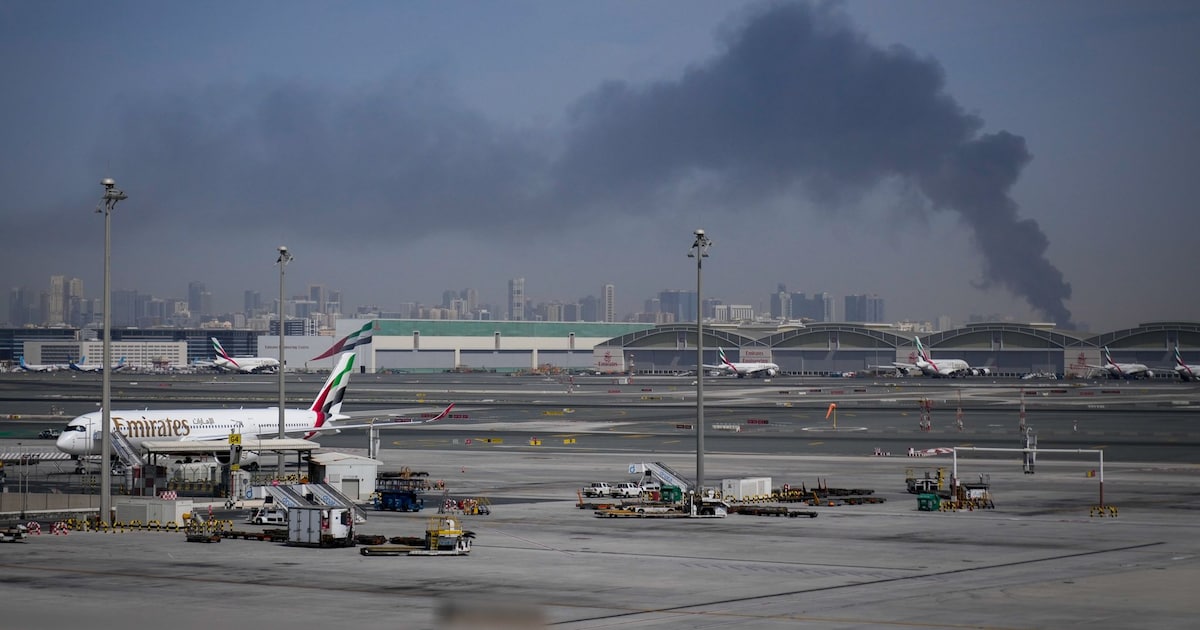
When commercial pilots take off in the Middle East these days, they come dangerously close to Iran’s attacks. Are they afraid? And what happens if a pilot rejects a route because of the current situation?
With a loud roar, the drone whizzes downwards and lands at Dubai International Airport – right next to one of the terminals and next to parked passenger planes, in the middle of the day.
The video of the attack a few days ago shows: Pilots in the Middle East are standing in view of the war with Iran before some of the most extraordinary days of her career. How do you steer a plane and its passengers safely to their destination when drones, rockets and cruise missiles are flying in the sky day and night?
“Pilots and cabin crew are prepared for difficult situations,” says an employee of a major airline in one of the Gulf states, who did not want to give her name or her employer.
“If pilots consider the conditions to be unsafe, they have the right to refuse the flight,” the employee, who also trains employees at the airline, told dpa. “Airlines will never allow an aircraft to fly in airspace that is deemed unsafe,” she assures.
Rare maneuvers in an exceptional situation
However, some passenger planes came dangerously close to the attacks in the Iran War in recent days. The Flightradar24 website showed how an Emirates plane coming from India on its way to Dubai suddenly turned around during ongoing missile attacks, but then – apparently after repelling the attack – turned around again and finally landed in Dubai. The maneuver known as “double reverse” is considered extremely rare.
Not all states are taking the risk. For example, the countries under attack, Iraq, Kuwait and Bahrain, have closed their airspace. Qatar and the United Arab Emirates, on the other hand, partially reopened them after tens of thousands of flights were canceled and many travelers were stranded.
An emergency system known as ESCAT is now in effect in both countries. Air traffic control can immediately prescribe course changes or landings for certain zones in the air, for example to enable drones and missiles to be launched there.
“Flights to problem regions are unavoidable”
For some pilots, the current situation is, to a certain extent, part of the job. “We’ve gotten used to it,” says a pilot from a major Arab airline. “It is inevitable that we are deployed in problematic regions.”
However, the pilot and co-pilot tried everything to keep risks as low as possible – for example with additional fuel for possible course changes or by asking for an alternative route, says the pilot. His airline also tries to swap routes if a captain doesn’t have a good feeling in advance.
“I wouldn’t want to fly in the area at the moment. The whole area is an active conflict zone,” writes a user on the pilot website PPRuNe. The airlines are “playing with fire and the lives of passengers and crews,” writes another.
Some in the pilot forum speak of “absolute madness” and predict that flights during the war would only continue until a major catastrophe occurs – be it through an accident or through the targeted shooting down of a passenger plane.
,regionOfInterest=(1087,817)&hash=2068e6b0b6e4db4ee98489ac783c2671ef44794f8953164be11c44c354c86965)
Such serious incidents have already occurred during conflicts in the Middle East. In 2020, Iran’s air defenses shot down a Ukrainian plane shortly after takeoff from Tehran amid military tensions with the United States.
All 176 inmates were killed. In 1988, a US cruiser shot down an Iranian passenger plane over the Strait of Hormuz – killing all 290 people on board. The European aviation safety authority EASA has already warned of “high risks” for flights over Iran and the region.
Complete highway closure in the sky
The attacks are also likely to cause major headaches for air traffic controllers in the region. The airspace closures are narrowing the routes that pilots can use on the way from Europe to Asia, for example. This corresponds to a kind of complete motorway closure in the sky for certain routes.
The hardened pilots in Lebanon now have a special reputation, having continued to fly for the state-owned Middle East Airlines (MEA) during the recent war between Israel and Hezbollah – sometimes within sight of the runway during ongoing explosions in Beirut. Serious attacks are now also occurring again in Lebanon and Israel as a result of the war.
“Business as usual – despite bombings”
In Beirut it is now “business as usual,” a representative at Beirut airport tells the dpa – “everything goes on as usual, day and night, despite all the bombing around us.” The pilots would continue to fly so that Lebanon “is not cut off from the rest of the world”.
Videos of the MEA planes taking off and landing over the city amid explosions and smoke fill some Lebanese with pride. A clip is circulating on Instagram from one such takeoff in which a voice from off says: “So you think your job is stressful. Try being a Lebanese pilot.”
The biggest concern at the moment is that an unguided rocket could hit the runway during takeoff or landing, says an MEA pilot. Apart from that, he makes it clear: “We simply don’t feel fear anymore.”