whizzy1919@gmail.com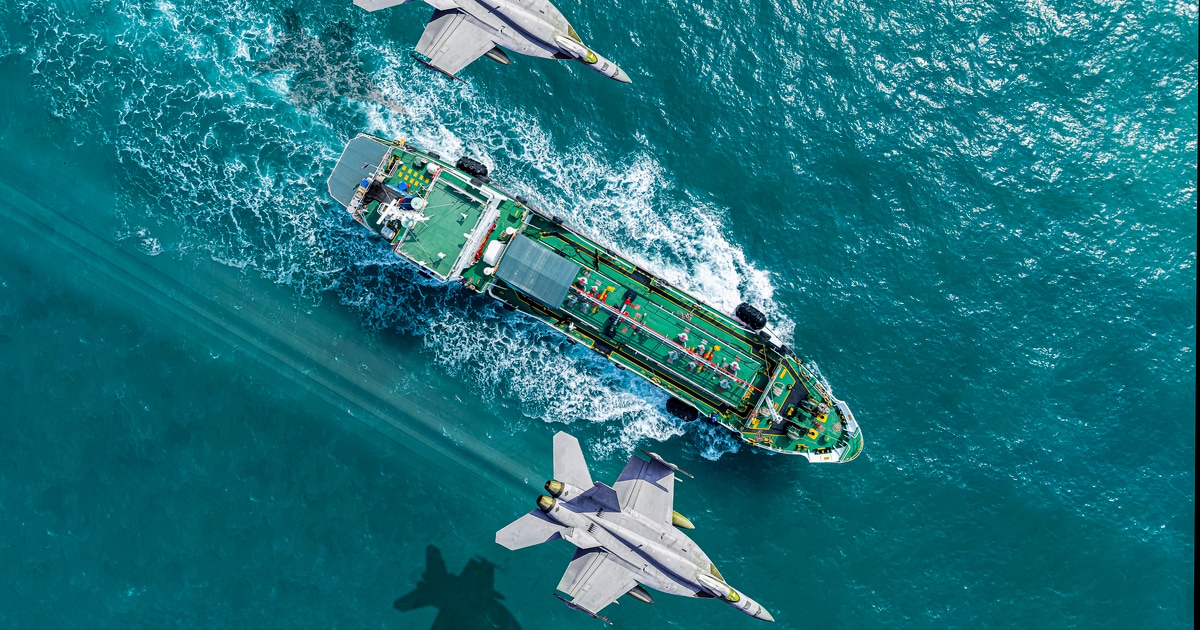
A burning freighter in the Strait of Hormuz shows that the job can be life-threatening for crews of merchant and tank ships. An officer describes the everyday life of his crew.
“We are powerless – we just wait and hope that nothing happens.” This is how a tanker officer describes his Situation near the Strait of Hormuz towards the British “Guardian“. His crew saw explosions in the sky while they were loading crude oil – at times without functioning GPS or communication. “We were sitting on more than a million barrels of oil,” said the sailor.
The tanker officer reports on a surreal everyday life on board. The crew is trying to continue working, but the situation is leaving its mark. “It feels increasingly unreal that we are just working normally here while there is war around us.” You can hear military aircraft over the sea. In the few free hours, some sailors went to the on-board gym, watched films or went fishing in the evening – but with as little light as possible “so as not to draw attention to the ship”.
The descriptions show how quickly civilian merchant ships can get caught up in geopolitical conflicts and how dangerous the job on the high seas is. Economists and security analysts are currently talking about a “low but highly concentrated risk” of being attacked. Statistically speaking, an attack is unlikely. However, when political tensions escalate, the danger increases abruptly.
Freighter burns in the Strait of Hormuz
However, a burning freighter in the Strait of Hormuz, evacuated sailors and threats of sea mines are already filling the news. Iran has already declared merchant and transport ships targets and has followed up threats with actions.
According to the British maritime safety authority “United Kingdom Maritime Trade Operations”, another cargo ship was hit by an “unknown projectile” in the strategically important strait on Wednesday. The impact caused a fire and the crew had to abandon ship.
“Tanker Wars” from 1980 show: merchant ships are popular war targets
A look at history shows what extent this can take on. During the so-called “Tanker War” in the Iran-Iraq War of the 1980s, more than 400 merchant ships were damaged in the Persian Gulf.
Incidents have also occurred again and again in recent history. In 2019, for example, two tankers near the Strait of Hormuz were damaged by explosives and 44 sailors had to be evacuated.
Since the current escalation began in 2026, authorities have reported several attacks on freighters and tankers and at least one death among sailors.
Insurers are now increasing premiums massively
The conflict in the 1980s also highlighted the central role insurers play in maritime crises. At that time, insurance premiums for ships in the Persian Gulf rose by 50 percent or even significantly more. For numerous shipping companies, the passage was no longer economically viable, which is why they changed their routes or called at alternative ports.
Similar effects can also be seen in the current conflict. The sharp increase in risk premiums for insurance has led to many shipping companies currently avoiding the passage through the Strait of Hormuz. According to industry sources, it is currently mainly Iranian and Chinese ships that are still sailing there, while the majority of international merchant shipping is suspending the route for the time being.
The crews bear the risk
For the people on board, geopolitical conflicts are not abstract news. Sailors in the region report explosions in the distance, military threats over the radio and the feeling of having little protection in an emergency.
The uncertainty hits crews particularly hard because many merchant ships fly international flags and crews come from different countries – such as the Philippines, India or Europe. Evacuations or crew changes quickly become a logistical challenge in a military escalation.
“You can’t just jump off the ship,” explains the general secretary of the International Transport Workers’ Federation, Stephen Cotton, in the Guardian. Many shipping companies have now classified the region as a “no-go zone”.
Added to this is the psychological burden. Seafarers are often “invisible to the public,” says Cotton, even though they work on the front lines of global trade. “Sailors are civilians. They just happen to be on a ship in a region that is currently extremely explosive.”
A job with underestimated risk
The incident in the Strait of Hormuz highlights a fundamental problem of the globalized economy: world trade depends on an industry that works largely invisibly – but carries enormous risks.
For shipowners and energy companies, passage through geopolitical crisis areas is an economic calculation.
For the people on the ships, however, it remains one thing above all: a job in which an ordinary working day can suddenly end in a war zone.