whizzy1919@gmail.com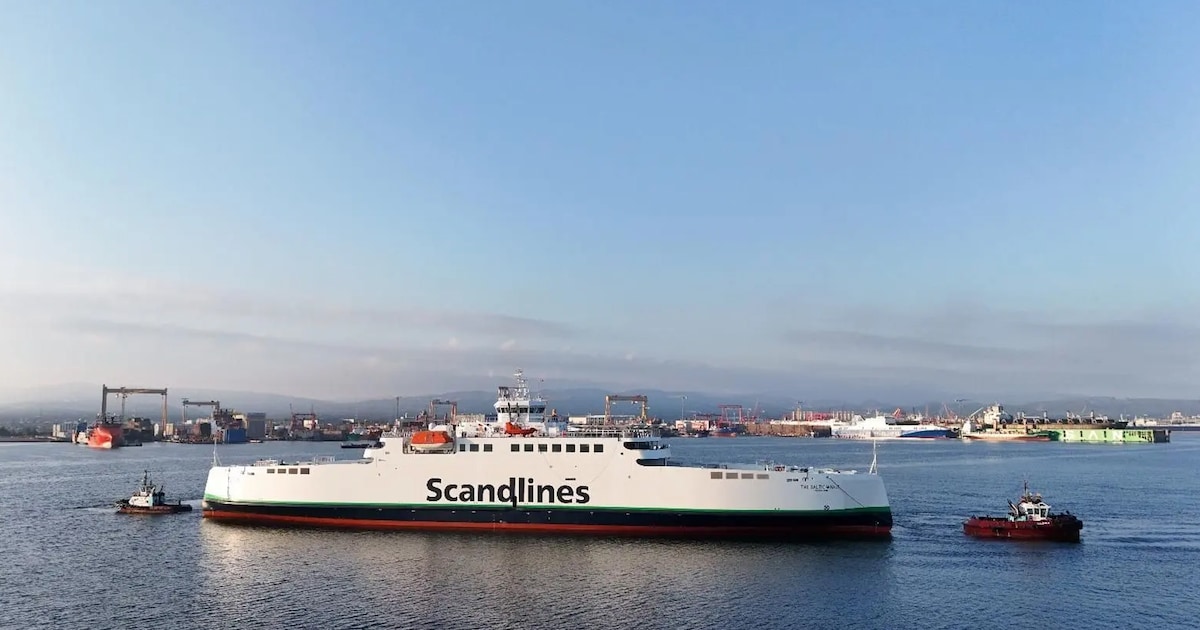
A huge battery ferry recently started connecting Germany and Denmark with zero emissions. The 84 million euro ship is a milestone – and a signal to an entire industry that is still deep in the oil age.
On Tuesday, “The Baltic Whale” set off from Rødby in Denmark for the first time and headed for the German Baltic Sea island of Fehmarn. There is no diesel smoke at all, because the new ferry is equipped with a huge battery system that stores ten megawatt hours of electrical energy. The freight ferry takes around 45 minutes to reach its destination in Schleswig-Holstein.
Those responsible at the Danish-German shipping company Scandlines have longed for this moment. You talk about a “milestone”. “We already had the idea for a battery-powered ferry in 2018, and now the time has come,” says Michael Guldmann Petersen, Managing Director of Scandlines. The shipping company dug deep into its pockets to implement the idea: the emission-free ferry cost 84 million euros.
Ship name with message
The name of the ship is no coincidence. She was after the Porpoise named, which is under strict protection. Noise and pollutant emissions from conventional ships threaten its survival in the Baltic Sea.
The “Baltic Whal”, on the other hand, is intended to reduce not only CO2 emissions, but also underwater noise – one of the most underestimated threats to marine mammals. Electric motors run almost silently, which should improve the porpoises’ orientation and communication.
,regionOfInterest=(2510,1703)&hash=b78264511391ebb8f97dec81aacdbf565971cb18e5df52b286511119f31bbddf)
Charge ten MWh in twelve minutes
The battery system on board is one of the largest ever installed on a ferry. Ten megawatt hours – which corresponds to the annual electricity requirement of around ten average single-family homes – are charged into the batteries in just twelve minutes during the short time in port. This is made possible by a new high-performance charging system in both ports, for which Scandlines laid a 30-kilovolt cable route with a 15-megawatt charging station.
A loading tower connects the ship to the power grid within less than 15 seconds of docking. Once charged, the ferry covers the 18.5 kilometers between Puttgarden and Rødby in 45 minutes without a single direct emission. There are diesel generators on board for emergencies, but they are not required for regular operation.
The ferry is designed as a pure freight ferry: It offers space for 66 trucks on two decks, but can also transport dangerous goods, such as industrial batteries, cosmetic products or car parts that are subject to special safety requirements. A maximum of 140 passengers are allowed to travel.
,regionOfInterest=(1419,685)&hash=afc881adeac697ed0da48cba7ea5c72d427992f074f95f4d1ba845b020f2e796)
Nabu demands turbo for all shipping companies
The German Nature Conservation Association, which has been advising Scandlines on converting to a greener fleet for years, was enthusiastic. “The maiden voyage of ‘The Baltic Whale’ is an important milestone for climate protection in shipping,” explained Nabu President Jörg-Andreas Krüger. The ferry proves that electrification at sea is no longer a promise of the future, but a reality.
But the nature conservation association also used the opportunity to make a clear demand to politicians. Nabu shipping expert Sönke DIESENER warned: “Other shipping companies must follow this example.” In the long term, all ferries in Germany should be operated electrically. “Technically speaking, there are hardly any excuses left,” said DIESENER.
This demand is receiving support from a current study by the European environmental organization “Transport & Environment“: According to this, around 60 percent of European ferries could be battery-electric and therefore emission-free by 2035. More than half could then even be operated more cheaply than with fossil fuels.