whizzy1919@gmail.com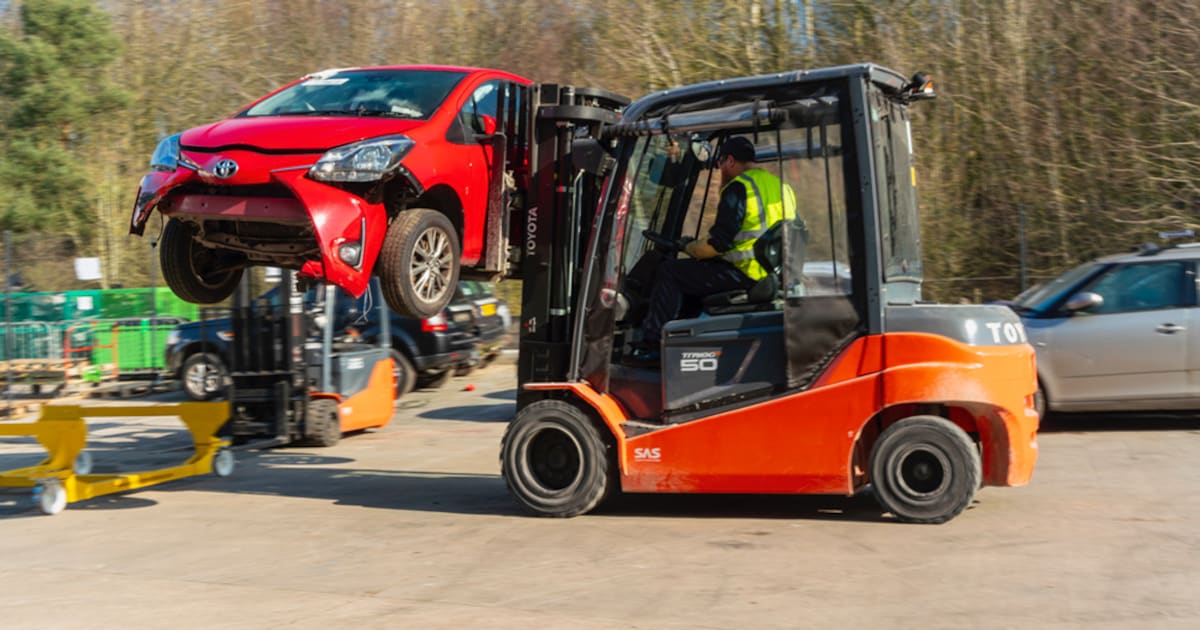
The auto giant is perfecting the industrial dismantling of vehicles to free itself from dependence on critical raw materials.
The airbag shoots out of the steering wheel of a Vauxhall Corsa with a loud bang. Seconds later, the passenger airbag and side and window bags follow. It is now clear at the latest: this car, which is over 20 years old, has had its day. No one was injured – the triggering was not an accident, but part of a controlled process. The car is dismantled and recycled at the Toyota factory in Burnaston, England. The airbags would just get in the way.
Here, where the Toyota Corolla used to roll off the assembly line, a second life begins for old cars – in individual parts. Toyota converted the hall into a so-called circular factory, the group’s first dismantling plant. Production of the Corolla was reduced after Brexit and a line was shut down. Now Toyota uses it the free capacity for a new business model.
“We are learning here how we can recover more recyclable materials in the future,” says Leon van der Merwe, responsible for circular economy and energy management at Toyota Europe. The factory is more than an experiment for the group: it should pay off in the long term – and solve strategic problems.
EU is putting pressure on us
Because the pressure is growing. Car manufacturers in Europe must decarbonize their production. Anyone who wants to continue building vehicles with combustion engines after 2035 must offset the resulting CO₂ emissions – for example by using recycled steel. At the same time, Toyota is sticking to hybrid drives. The plants should therefore be climate-neutral by 2040.
There is also another risk: dependence on raw materials from politically unstable regions. This increasingly also applies to batteries and electric drives. “Comparatively few electric cars are still arriving here,” says van der Merwe. “But hybrid vehicles do. Here, too, we are learning how valuable materials can be recovered.”
However, the practical implementation is more complex than expected. The approximately 400 employees in Burnaston discovered: A car is much easier to build than to disassemble. Toyota has perfected its production over decades; the TPS production system is considered a benchmark worldwide. The core elements are the avoidance of waste (“Muda”) and continuous improvement (“Kaizen”).
Second dismantling plant will soon start in Poland
Now the company is taking the principle further – in the opposite direction. “We have developed vehicles for efficient production. Now we have to learn to design them for efficient dismantling,” says van der Merwe. The goal: a “reverse TPS”. Toyota wants to share the knowledge gained with the industry – as with the classic production system.
Burnaston is just the beginning. A second dismantling plant is being built in Walbrzych, Poland, the former Waldenburg, and is scheduled to open at the end of 2026. Step by step, Toyota wants to build a Europe-wide network of such systems in order to industrially dismantle cars it produces and recover valuable parts and materials.
The process itself is precisely timed: it takes around three hours for a vehicle to be completely dismantled. After the airbag is deployed, the wheels, engine, transmission, chassis and finally the plastic parts follow. They in particular represent a challenge. On average, a 20-year-old car contains around 170 kilograms of plastic, while modern electric cars contain around 260 kilograms.
Plastics make recycling difficult
The EU is increasing the pressure even further: from 2032, 25 percent of the plastics in new cars must come from recycled material. But the variety of plastics used makes recycling considerably more difficult. Metals are simpler: steel and aluminum can be recycled comparatively efficiently. Engines are already being made from recycled aluminum in Burnaston.
Another component is particularly lucrative: the catalytic converter. It contains precious metals such as platinum, palladium and rhodium – raw materials with a high market value. Experts see similar potential in the future in the batteries of electric cars as soon as larger numbers of them reach the end of their life cycle.
However, the business is still in loss. This year around 12,000 cars will be dismantled in Burnaston – a fraction of new car production next door, which is around ten times higher. The proceeds from the recovered materials do not yet cover the costs.
But Toyota relies on learning curve effects. It should be seen within three years whether the concept is economically viable. If this succeeds, the industrial dismantling of cars could become the next brilliant idea for the entire industry.